For teachers
Classroom treasure hunts with maths and science questions
Worked questions, practical pupil roles and a lesson plan that leaves time to explain the answers.
A classroom treasure hunt can give pupils a reason to calculate, compare evidence and explain an answer to someone else. Plan the learning first, then choose the story and route that make those conversations practical.
This guide offers worked question examples, a lesson timetable and pupil roles, alongside actual clue and teaching-brief pages from a Space Rescue demo. Use it as a planning starting point and adapt it to your class.
1. Start with the learning you want to practise
Choose a precise goal such as converting metres to centimetres, reading a table, identifying a complete circuit or explaining what makes a comparison fair. A broad “maths and science” trail is useful for mixed practice; a narrower focus makes the follow-up discussion easier to plan.
In PartyTrail, choose School classroom in the builder, then select the age, player count, subjects and available topics. The story theme is a separate choice: a space adventure can still contain maths and science questions.
Read the generated questions and adult learning brief before the lesson. Decide which answers need a drawing, a spoken explanation or a quick written calculation. Age settings are a starting point; use your knowledge of pupils’ reading and learning needs.
2. Use questions pupils can explain
The first four questions below are original practice examples for this guide. The final conversion question also appears on the actual classroom demo card shown later. Adapt the vocabulary or provide a drawing when a pupil needs help accessing the task.
Early number practice
There are four clue cards on one tray and three on another. How many cards are there altogether?
Show answer and explanation
7 cards.
Combine the two groups: 4 + 3 = 7. Ask pupils to show the groups with marks or a drawing.
Equal groups
Three teams each collect four paper stars. How many paper stars have they collected altogether?
Show answer and explanation
12 paper stars.
There are three equal groups of four: 3 × 4 = 12. Ask how repeated addition shows the same result.
Science: changing state
An ice cube warms up and melts. Is the melted water a solid, a liquid or a gas?
Show answer and explanation
A liquid.
Melting changes solid water into liquid water. This question can be discussed using a drawing; no live experiment is needed.
Science: a complete circuit
A working battery-powered circuit has one unbroken loop containing a bulb and a switch. The switch opens and makes a gap. Will the bulb stay lit?
Show answer and explanation
No.
The gap breaks the complete conducting path, so current cannot continue around that simple circuit. Pupils can trace the loop on a paper drawing.
From the actual age-nine demo
A rope is 1.25 metres long. What is its length in centimetres?
Show answer and explanation
125 cm.
One metre is 100 cm, and a quarter metre is 25 cm. Add them: 100 + 25 = 125 cm. On the demo card, pupils then use its printed answer key to find the next instruction.
Keep the calculation and the route instruction distinct. A pupil may have the right numerical answer but still need to check the card’s key. Asking “What did you work out, and what does the key tell you next?” helps you see both steps.
3. Organise the room and the pupil roles
Select only hiding places you can use that day. A labelled tray, a low book shelf, the whiteboard area or the outside of a teacher’s desk can work when access is clear. Use an envelope beside an object when searching inside it would disrupt the classroom.
- Set a clear play boundary and explain how pupils move between clues.
- Keep private work, other pupils’ possessions and staff-only areas outside the game.
- Assign rotating reader, solver, checker and messenger roles.
- Offer seated solving, enlarged text, reading support or a collected envelope to suit pupils’ needs.
- Place cards using the adult setup map, then check the route before the lesson.
PartyTrail supports up to 30 players. The route depends on your selected player count, so use the starting-card assignments in your own pack. A simple four-person role pattern is a classroom organisation idea; it does not change the printed route.
4. Plan time to think and explain
| Lesson stage | Example time | Teacher focus |
|---|---|---|
| Brief the class | 5 minutes | State the learning goal, route rules and roles. |
| Solve the trail | 25 minutes | Listen for explanations and note a misconception to revisit. |
| Share reasoning | 10 minutes | Discuss one maths method and one science explanation. |
| Exit question and buffer | 5 minutes | Ask one short follow-up question and collect materials. |
A useful prompt during play is “Which detail supports that answer?” For a calculation, invite a second method. For science, ask pupils to identify the observation or rule they used. Offer a small hint, allow thinking time and then let the group try again.
See a real clue and adult learning brief
These are actual pages from a newly generated Space Rescue classroom demo for twelve pupils aged nine, with maths and science selected.
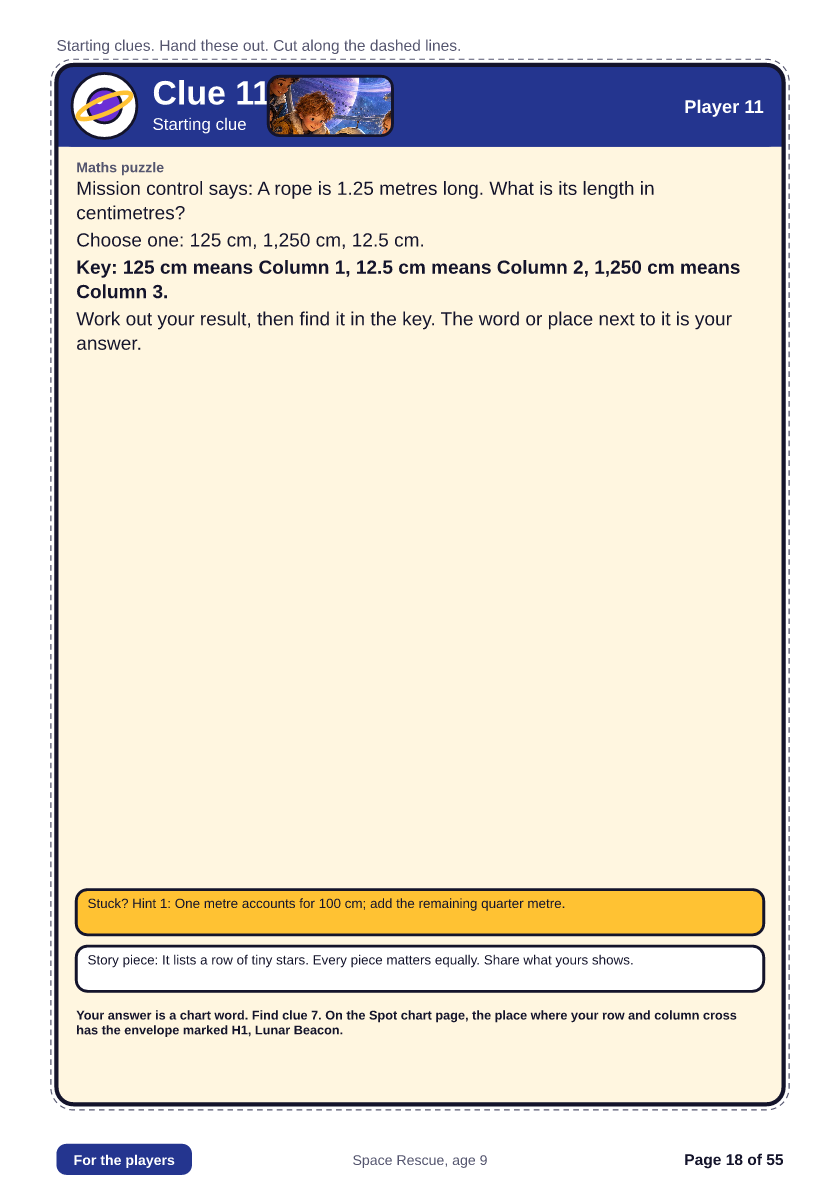
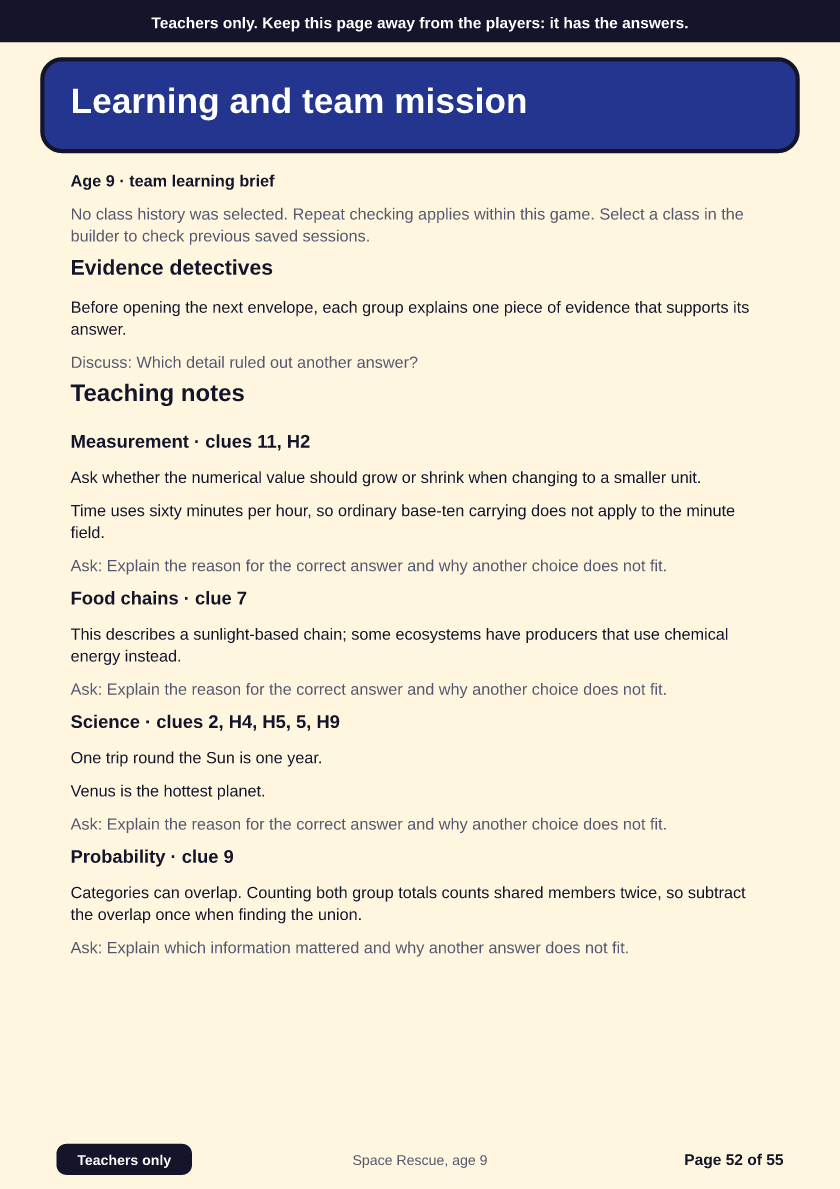
The adult brief includes explanations and teaching notes for the generated game, plus discussion and follow-up ideas. Keep these pages with the teacher while pupils use their assigned clues.
5. Plan the next session with purpose
A class profile can keep question history across saved sessions. Give it a class nickname, keep its private code with staff and use that code when continuing on another device. Pupil names and individual scores are not required.
Fresh mode excludes questions already recorded for that class; review mode deliberately allows familiar questions. Skills and task structures can recur. Rotate the learning focus to cover different topics, and use review when you want pupils to revisit an idea.
A narrow topic can run out of unused questions. The practical goal is useful practice and discussion, so inspect each preview and decide whether a fresh challenge or a deliberate revisit serves the lesson better.
Common questions
Can I choose a story separately from the school subject?
Yes. The theme and learning focus are separate choices. Select a theme, choose School classroom, then choose the available subjects and topics you want to practise.
Does a treasure hunt replace assessment?
Use the trail as an activity alongside your own teaching and assessment. Listen to pupils’ explanations, check their work and use a short follow-up question to decide what needs revisiting. The pack does not record individual pupil scores.
Do the science clues require equipment?
The examples in this guide use words and paper drawings. Read your generated pack before the lesson to see the tasks it contains and choose settings appropriate to your classroom.
Plan your classroom adventure
Explore the classroom options, then choose a theme and learning focus for your pupils.
Explore classroom treasure huntsWant a short activity first? Try the free five-clue mini hunt