Classroom activities
Multiplication treasure hunt: 8 times-table challenges
Eight copyable station cards that connect arrays, equal groups and missing factors to a shared code.
A multiplication treasure hunt can ask pupils to do more than recall a fact quickly. They can draw equal groups, interpret an array, find a missing factor and explain why two methods reach the same total.
This eight-station quest is designed as a roughly 30-minute primary lesson for ages 7–10, using facts built from the 2, 4, 5 and 6 times tables. Match the cards to what your pupils have learned. It is a complete handmade classroom activity to copy from the article, separate from a generated PartyTrail pack.
Prepare the eight stations
Copy the eight prompts below onto cards numbered 1–8. Keep the answers on your teacher copy. Put cards at eight reachable tables or wall positions, clear of doorways. Each team needs a sheet numbered 1–8, a pencil and optional counters or squared paper.
| Lesson stage | Time | What pupils do |
|---|---|---|
| Model one equal-group example | 5 minutes | Draw a method and explain what each number represents. |
| Station quest | 15 minutes | Visit cards, discuss and record answers and methods. |
| Decode and compare | 5 minutes | Use the teacher-revealed key to build the word. |
| Exit explanation | 5 minutes | Explain one fact without relying only on recall. |
For 24 pupils, six teams of four can start at different stations. For 30, use ten teams of three and duplicate two busy cards, or let some teams solve at their desks first. A team can also stay seated while an adult rotates cards. Do not remove a station card after solving it.
Eight multiplication challenges with worked answers
Station 1 — equal groups
Three envelopes each hold two paper keys. How many keys altogether?
Show answer and explanation
6 keys.
There are three equal groups of two: 2 + 2 + 2 = 6, or 3 × 2 = 6.
Station 2 — missing factor
Two equal rows hold 16 counters altogether. How many counters are in each row?
Show answer and explanation
8 counters.
2 × 8 = 16. Divide 16 into two equal groups or count in twos to check the missing factor.
Station 3 — array
Draw an array with three rows of four. How many squares does it contain?
Show answer and explanation
12 squares.
4 + 4 + 4 = 12. Turn the array to show four rows of three; the total stays 12.
Station 4 — repeated addition
Four + four + four + four represents how many counters? Write a matching multiplication.
Show answer and explanation
16 counters.
Four groups of four make 16, written 4 × 4 = 16.
Station 5 — check a claim
A pupil says five bags of four tokens contain 20 tokens. Is the claim correct? Show a check.
Show answer and explanation
20 tokens; the claim is correct.
5 × 4 = 20. Draw five groups, add 4 five times, or use 10 × 4 = 40 and halve it.
Station 6 — adjust a known fact
Seven trays hold four markers each. One full tray is taken away. How many markers remain?
Show answer and explanation
24 markers.
7 × 4 = 28; taking away one group of four leaves 24. This is the same as 6 × 4.
Station 7 — rectangle
A paper grid has five rows with six squares in every row. How many squares cover it?
Show answer and explanation
30 squares.
5 × 6 = 30. Count five equal rows of six; swapping rows and columns gives 6 × 5.
Station 8 — a square array
Six rows each contain six star symbols. How many stars are there?
Show answer and explanation
36 stars.
6 × 6 = 36. Split into five rows of six plus one more row: 30 + 6 = 36.
Reveal the answer-to-letter key
When teams have attempted the cards, reveal this key. Replace each answer with its letter and read the letters in station-number order. Keep the key back initially if you want pupils to reason before using the available totals as clues.
| Answer | Letter |
|---|---|
| 6 | D |
| 8 | I |
| 12 | S |
| 16 | C |
| 20 | O |
| 24 | V |
| 30 | E |
| 36 | R |
The word is DISCOVER. A word that does not read correctly is a prompt to revisit a station, not a reason to eliminate the team. Ask the checker to choose one answer and show why it belongs in the key.
Adapt for different times-table confidence
- For pupils still building equal groups, use counters and attempt stations 1, 3, 4 and 5 first. Give the remaining letters after discussing those methods.
- For a narrower times-table focus, rewrite the prompts and create a new matching key; the old letters will not automatically fit changed answers.
- For confident pupils, ask for a second representation, such as an array and a related division fact.
- Use rotating reader, modeller and checker roles. An accurate drawing is a contribution even when another pupil knows the fact instantly.
Plan the next learning session
Keep one example of a clear method and one misconception to revisit. If pupils confused the number of groups with the amount in each group, start next time with a physical or drawn model before another code quest.
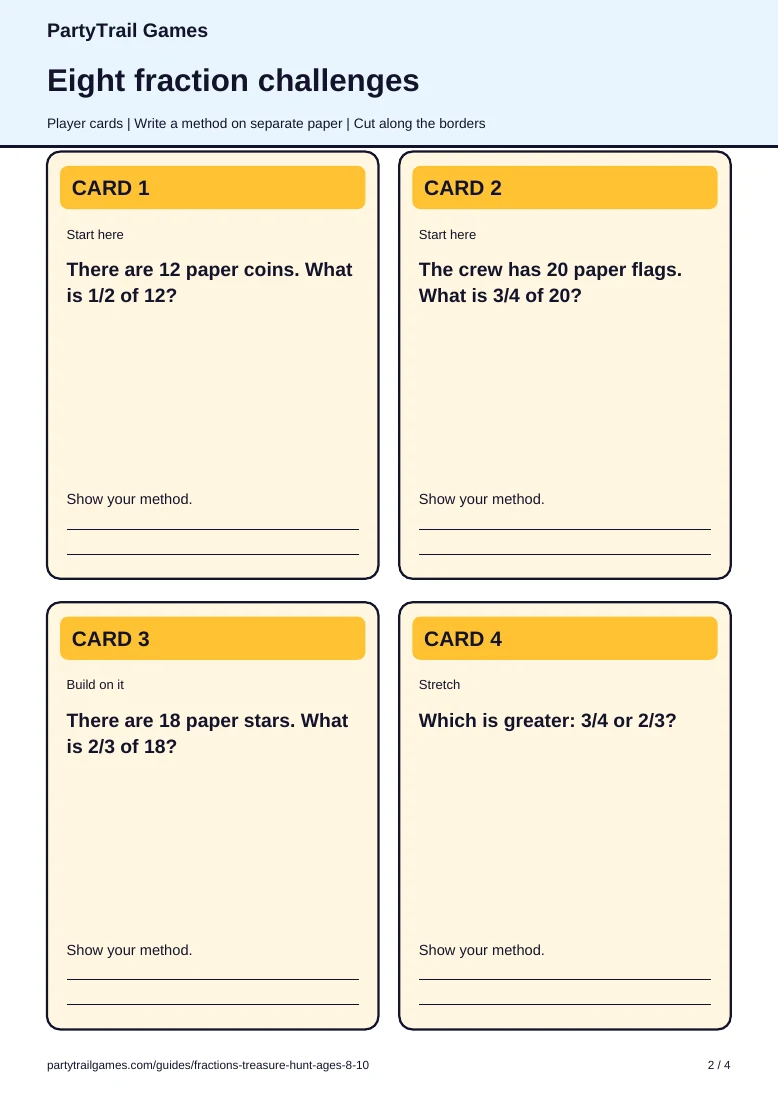
For a personalised PartyTrail classroom game, select a maths focus and inspect the generated questions and teacher brief. Its branching clue route and envelope labels are separate from these eight stations. The free fractions card set is another ready-to-print activity if your class is working on that topic.
Common questions
Is this suitable for Year 3 or Year 4?
It can be, if the selected facts and representations match your class. The age range is a guide; review all eight cards against what pupils already know and adapt before the lesson.
Do I need eight separate tables?
No. Cards can be on reachable wall positions, at desk stations or rotated by an adult. Keep routes clear, and let seated teams use the same questions.
Is there a separate multiplication card PDF?
Not for this article. Copy the eight prompts onto cards or print the article. The linked fractions activity and free mini hunt have their own downloadable PDFs.
Put maths inside a story mission
Choose a classroom theme and question focus, then inspect the game and teacher guide before printing a full personalised adventure.
Explore classroom gamesWant a short activity first? Try the free five-clue mini hunt