Classroom activities
End-of-term classroom games: a 45-minute team quest
Celebrate what the class has learned with four cooperative games and a shared finish, without an elimination round.
An end-of-term lesson can celebrate the class without becoming an hour of waiting for a turn. A shared quest gives pupils something to explain, make and contribute, while leaving a few minutes to reflect on what they have learned.
This 45-minute primary classroom plan combines four cooperative games: retrieval detectives, a code puzzle, a class museum and a thank-you mission. Use ages 6–11 as a rough guide, adapt the questions to your actual teaching and keep all pupils involved until the finish.
The 45-minute classroom plan
| Time | Game or transition | Preparation |
|---|---|---|
| 0–5 minutes | Briefing and team roles | Put pupils in teams of 3–5 and explain the shared finish. |
| 5–15 minutes | Retrieval detectives | Three familiar questions on each table. |
| 15–25 minutes | Repair the class code | Four numbered panels and one answer sheet per team. |
| 25–35 minutes | Build a class museum | Paper exhibit labels and pencils. |
| 35–42 minutes | The thank-you mission | One short note or spoken contribution per pupil. |
| 42–45 minutes | Reveal, reflect and tidy | A shared “Mission complete” message. |
You need paper, pencils and copies of the code prompts. Museum exhibits can be drawings rather than objects. For 30 pupils, six teams of five can stay at their own tables. Assign a reader, recorder, checker and encourager; combine or share jobs to fit the group.
Game 1: retrieval detectives
- Ages
- 6–11, using previously taught content
- Group
- Teams of 3–5
- Preparation
- 5–10 minutes
- Playing time
- 10 minutes
Materials: Three question cards and scrap paper.
Learning goal: Retrieve familiar ideas and explain the evidence for an answer.
How to play
- Give each team one remember question, one explain question and one create-an-example question from a topic already studied.
- Let pupils think individually, then agree a response together.
- Ask the checker to identify a claim that needs evidence. Share a method, not just the team’s score.
Make it easier
Offer pictures, word choices or a read-aloud version.
Add a challenge
Ask teams to invent a plausible wrong answer and explain why it fails.
Talk about it: Which explanation helped someone else understand a familiar idea?
For example, after work on equal groups: remember 3 × 4; explain why 4 × 3 has the same total; create a short story that fits 12 ÷ 3. Check that the language and facts match what was taught rather than assuming every class has covered the same material.
Game 2: repair the class code
Copy these four panels onto numbered cards. Every team answers all four. Reveal the number-to-letter key afterwards, then read the letters in panel order. These example questions are suitable only if the class has met the ideas; otherwise replace them and make a new key.
Panel 1
Three pairs of paper flags contain how many flags altogether?
Show answer and explanation
6 → T.
A pair is two; 3 × 2 = 6.
Panel 2
There are eight blue counters and four yellow counters. How many counters altogether?
Show answer and explanation
12 → E.
8 + 4 = 12. The colours distinguish groups but do not change the total.
Panel 3
A team has 20 tokens and uses two. How many remain?
Show answer and explanation
18 → A.
20 − 2 = 18.
Panel 4
Continue the pattern: 6, 12, 18, __.
Show answer and explanation
24 → M.
Add six each time. The next term is 18 + 6 = 24.
The key is 6 = T, 12 = E, 18 = A, 24 = M, giving TEAM. Ask a different pupil to explain each panel. If a team is stuck, provide a drawing or a first step so everyone can reach the shared finish.
Game 3: build a class museum
- Ages
- 6–11
- Group
- Table teams, then the whole class
- Preparation
- 2 minutes
- Playing time
- 10 minutes
Materials: Paper exhibit labels and pencils.
Learning goal: Select and explain evidence of learning.
How to play
- Ask every pupil to draw one thing they learned or improved during the term.
- In teams, arrange the drawings into a museum with a short title for each exhibit.
- Choose one exhibit to explain to another table, including what the pupil understands now that was difficult before.
Make it easier
Use sentence starters such as “I can now…” or allow a dictated label.
Add a challenge
Connect two exhibits with an explanation of how the ideas relate.
Talk about it: Which exhibit shows a change in understanding rather than just a finished product?
Keep contributions about school learning and comfortable experiences. Do not require pupils to disclose private family events, explain an absence or compare their attainment publicly.
Game 4: the thank-you mission
- Ages
- 6–11
- Group
- Individual contributions to a class finish
- Preparation
- 2 minutes
- Playing time
- 7 minutes
Materials: Paper strips or a shared class sheet.
Learning goal: Notice specific helpful actions and acknowledge contributions.
How to play
- Invite each pupil to name, draw or write a helpful action they noticed during the term.
- Use specific actions such as explaining a method, lending a pencil or including someone in a game.
- Collect the contributions into a class display or read a few with permission. Finish with a shared mission-complete message.
Make it easier
Offer action examples and let pupils point or dictate.
Add a challenge
Ask how one helpful action changed what the group could achieve.
Talk about it: What would you like our class to keep doing next term?
Keep one idea for next term
Use the final three minutes to collect one activity pupils want to revisit and one question they still have. Save those ideas as planning notes, not a promise that every lesson will become a game.
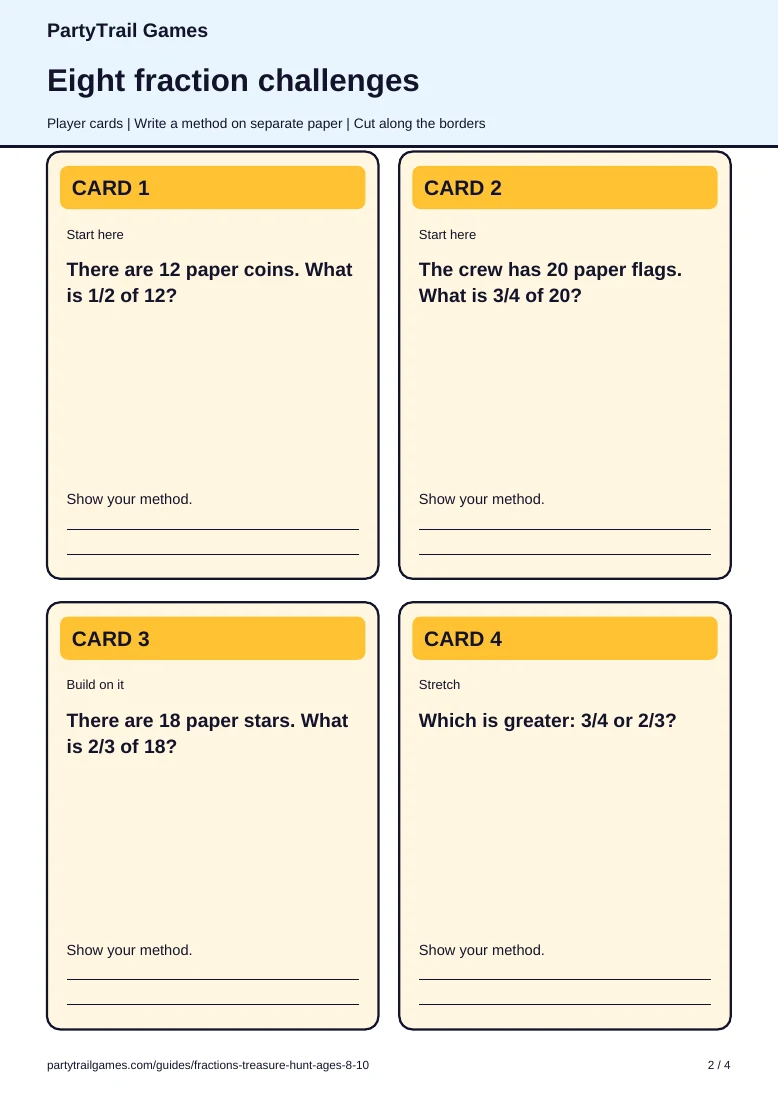
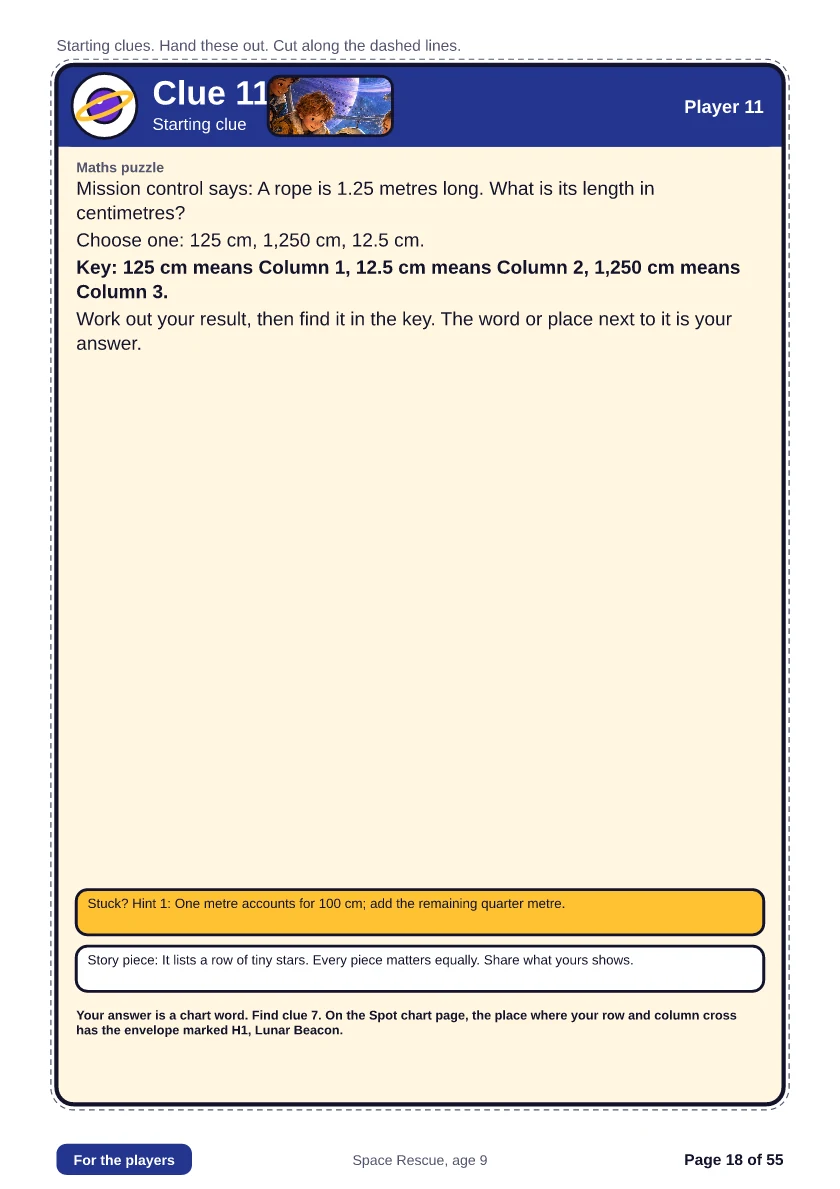
For a longer classroom treasure quest, choose a PartyTrail story and question focus, check the preview and set up using its teacher guide. Its printable pack is separate from these four games. If you need a larger-group station activity, the linked 10–30-player guide includes a complete six-station code quest.
Common questions
Can this work without children moving around the room?
Yes. All four games can stay at table groups. Rotate cards or share exhibits by holding up drawings rather than making a walking circuit.
What should I change for younger primary pupils?
Read prompts aloud, use counters and pictures, accept dictated labels and shorten each round. Choose content already familiar to the pupils.
Can I use it before Christmas or the summer holidays?
Yes. The structure is not tied to one celebration. Adapt the reflection to the term and keep participation comfortable for children with different backgrounds.
Plan another shared classroom mission
Explore story-led printable games with subject choices, worked answers and teacher setup guidance.
Explore classroom adventuresWant a short activity first? Try the free five-clue mini hunt