Large-group games
Indoor games for large groups of kids: 10–30 players
Five practical indoor activities, team roles and a complete six-station code quest for 10–30 children.
Looking for indoor games for a large group of kids? For 10, 20 or 30 children, a shared mission and small working teams give more children a useful part to play. These five activities suit birthday parties, primary classrooms and supervised clubs.
The plans below include supplies, group sizes, roles and a six-station code quest you can copy onto paper. Ages and times are planning suggestions: adapt them to reading confidence, the room and the adults available. They are not results from a recorded playtest.
Set up for 10, 20 or 30 children
| Children | Example teams | How to organise the room |
|---|---|---|
| 10 | Three teams of 3, 3 and 4 | Use three starting points and rotate through the six quest stations. |
| 20 | Five teams of 4 | Give teams different starting stations and a direction for the next move. |
| 30 | Six teams of 5 | Use six stations with one team starting at each, then rotate together. |
In a team of five, try reader, recorder, checker, materials organiser and spokesperson. Rotate after each round. With fewer children, combine roles; anyone can ask an adult to read. Check the room capacity and supervision arrangements before inviting a group.
Explain the play boundary, a walking rule and the signal for pausing. Put stations beside tables or on low surfaces, away from doors, stairs, heaters and stored equipment. Children should not need to climb or move furniture. Bring station materials to a seated team when that works better.
1. Six-station code quest
- Ages
- 5–12, with adapted questions
- Group
- 10–30 children in 3–6 teams
- Preparation
- About 15–20 minutes
- Playing time
- About 35–45 minutes
Materials: Six numbered paper station cards, one answer sheet and pencil per team, plus a folded answer-and-letter slip at each station.
How to play
- Copy the six questions below onto separate numbered cards. Keep each answer and code letter on a folded slip rather than on the question face.
- Give every team six numbered answer spaces. Start teams at different stations and agree one direction for moving between them.
- Allow about four minutes per station. Everyone suggests or checks an answer before the team checker opens its folded slip. Record the letter in the matching numbered space.
- Rotate the team roles and move to the next station at the adult’s signal. Leave every station card and answer slip in place.
- After six rounds, read spaces 1–6 in order to reveal TEAMUP. Invite each team to explain one answer, then read a shared finishing message.
Make it easier
Read aloud and replace the calculations with smaller numbers. Let children draw an answer or dictate it to a recorder.
Add a challenge
Ask teams to write a second method or create a new question that has the same answer.
Talk about it: Which team role helped you notice a mistake, and how did you check it?
| Station | Question to copy | Answer for the folded slip | Code letter |
|---|---|---|---|
| 1 | A team finds 4 red paper stars and 5 blue paper stars. How many stars altogether? | 9, because 4 + 5 = 9. | T |
| 2 | How many sides do one triangle and one square have altogether? | 7 sides: 3 + 4. | E |
| 3 | Which would a magnet attract: an iron paperclip, a wooden peg or a paper leaf? | The iron paperclip. Iron is a magnetic material. | A |
| 4 | Rearrange L, E, A, F to name a part of a plant. | LEAF. | M |
| 5 | Draw a grid with columns A, B, C from left to right and rows 1, 2, 3. Start at A1 and move two squares to the right. Where are you? | C1: A1 to B1 to C1. | U |
| 6 | Share 12 paper tokens equally between 3 explorers. How many does each get? | 4 tokens each: 12 ÷ 3 = 4. | P |
A challenge for confident solvers
A team has 3 envelopes with 4 tokens in each. They give away 5 tokens. How many remain?
Show answer and explanation
7 tokens.
First find the total: 3 × 4 = 12. Then subtract the tokens given away: 12 − 5 = 7. The team can also show three groups of four with marks on paper.
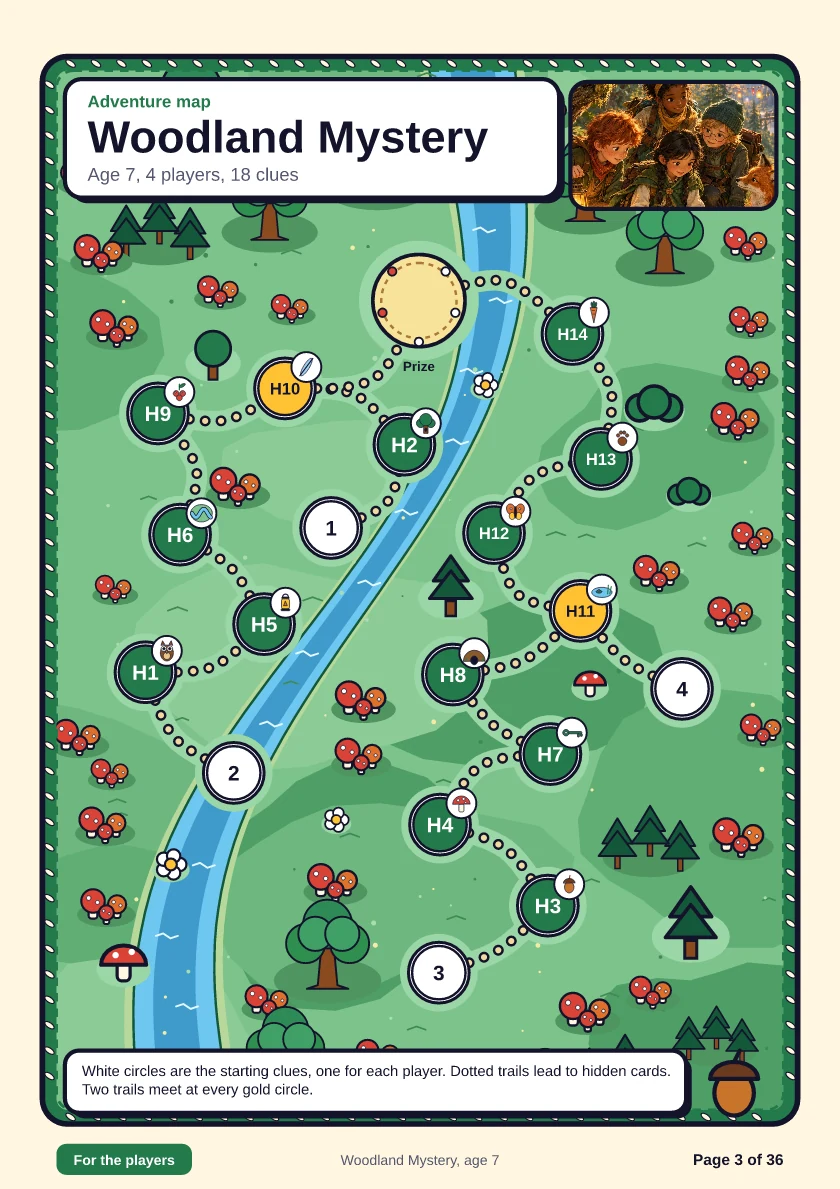
This handmade station game has its own rules. If you choose a personalised PartyTrail treasure hunt instead, set the actual player count in the builder and follow that PDF’s starting assignments and adult setup map. Do not replace its branching route with the station rotation above.
2. Team memory tray
- Ages
- 5–12
- Group
- 10–30 children in 3–6 teams
- Preparation
- About 5 minutes
- Playing time
- About 10–15 minutes
Materials: One tray, a cloth, six to ten familiar objects and team paper and pencils.
How to play
- Place familiar objects on the tray and name them aloud so everyone knows the vocabulary. Use a photograph or a separate close-up viewing turn if the whole group cannot see clearly.
- Let teams look for about 30 seconds, then cover the tray. Give everyone quiet thinking time before team discussion.
- Ask teams to record or draw as many objects as they remember. Rotate the recorder for the next round.
- Reveal the objects and let each team add one remembered detail. For another round, remove one object or change two positions.
Make it easier
Use four objects and accept pointing, drawing or spoken answers.
Add a challenge
Ask for both an object’s name and its position, then discuss the strategy used to remember.
Talk about it: Did grouping objects by shape or use help your team remember them?
3. Paper bridge mission
- Ages
- 6–12 with adult help
- Group
- 10–30 children in 3–6 teams
- Preparation
- About 10 minutes
- Playing time
- About 15–20 minutes
Materials: Two sheets of scrap paper per team, two stable books per team, a ruler and one eraser for a shared adult-led test.
How to play
- Set the two books about 10 cm apart on a stable table. The challenge is to make a paper bridge across the gap.
- Give each team the same amount of paper. Let them fold or roll it, agree a design and predict whether it will hold the eraser.
- An adult places the same eraser gently at the centre of each bridge for five seconds. Record what happens without ranking the children.
- Invite teams to change one feature and retest. Compare what changed in the structure and what stayed the same in the test.
Make it easier
Show an accordion fold and let children choose between that and a flat sheet.
Add a challenge
Keep the paper amount fixed and investigate how increasing the gap changes the result.
Talk about it: Why is it useful to use the same eraser and gap when comparing designs?
4. The missing-key story chain
- Ages
- 5–12
- Group
- 10–30 children in small circles
- Preparation
- About 5 minutes
- Playing time
- About 10–15 minutes
Materials: Paper and pencils; optional picture prompts of a key, a moon, a bridge and a tree.
How to play
- Start each team with “Our explorers found a silver key, but its door was missing…” Give the team one shared mission: explain where the door is and how everyone helps.
- Each child adds one sentence, a drawing or a choice between two suggestions. Allow anyone to pass and contribute later.
- After everyone has had a turn, teams choose an ending that connects to the opening key.
- A spokesperson or adult reads each team’s ending. Invite the larger group to spot one detail that was carried through the story.
Make it easier
Use picture choices and let an adult join the sentences.
Add a challenge
Ask teams to include a clue that only makes sense at the end, then explain it.
Talk about it: Which earlier detail made your ending work?
5. Team pattern detectives
- Ages
- 5–12 with an age-appropriate pattern
- Group
- 10–30 children in 3–6 teams
- Preparation
- About 5–10 minutes
- Playing time
- About 10–15 minutes
Materials: Number or shape cards, paper and pencils.
How to play
- Show every team the same pattern, such as circle, square, circle, square. Ask for the next item and the rule.
- Give each child a thinking turn before choosing a team answer. The checker asks whether the rule fits every step.
- Try a number round: 2, 5, 8, __. The next number is 11 because each step adds 3.
- Rotate the spokesperson, then let teams invent a pattern for another team to solve. Ask the inventing team to keep its rule on a folded answer slip.
Make it easier
Use large shapes and a simple repeating pair, with shape names as well as colours.
Add a challenge
Ask whether another rule could fit the displayed examples and what extra example would help decide.
Talk about it: How can you show that your rule works for all the examples?
Choose a classroom activity or a party adventure
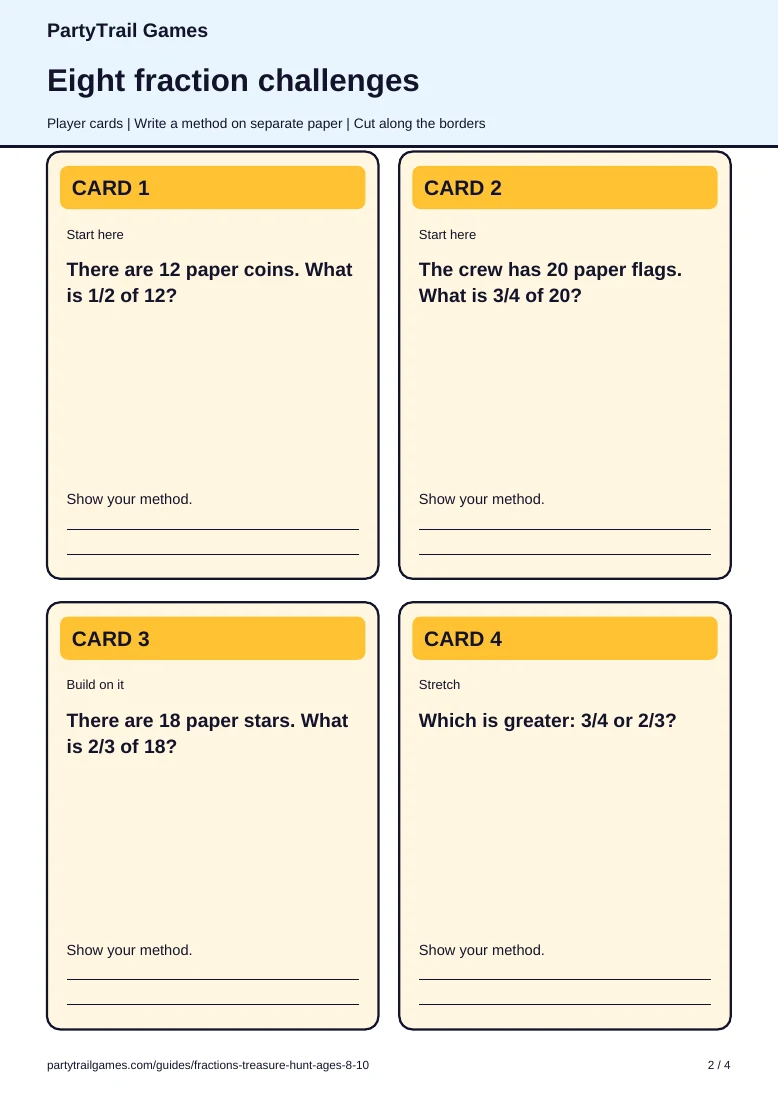
For classroom activities, decide the learning goal first and leave time to hear the explanations. The free fractions activity has eight worked maths cards for pupils around ages 8–10; select them using prior learning. A personalised classroom game can use maths, science or another available subject focus.
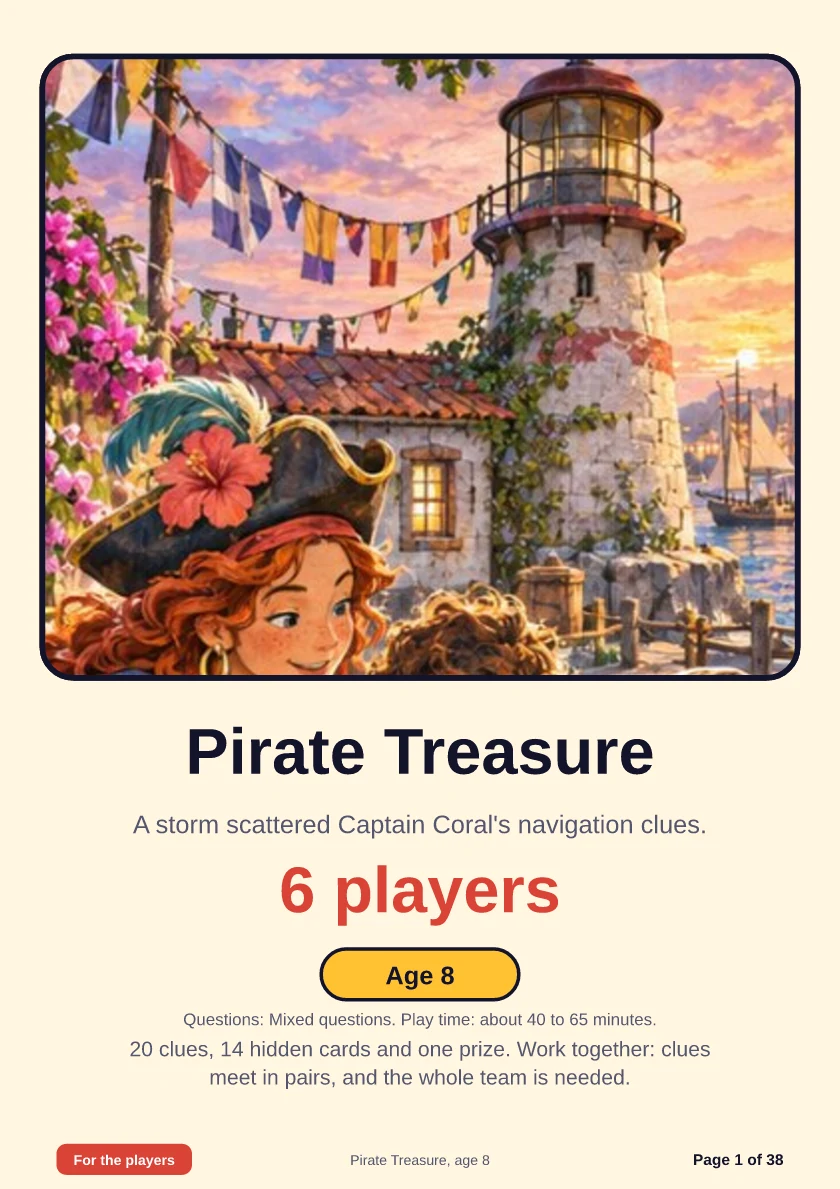
For an indoor birthday party, choose a story the group will enjoy, prepare the cards before guests arrive and plan a shared finish. PartyTrail makes printable treasure hunt games for 1–30 players aged 5–12. One new full pack is £3.80 GBP or US$4.99 USD, with no account or subscription required. Paper, printing, supervision and any prize are supplied by you.
Common questions
What indoor game works for 30 kids?
Try six teams of five using six reachable stations, with different starting points and a shared rotation signal. The six-station code quest above includes questions and answers you can copy. Check the room and supervision arrangements, rotate team roles and adapt the tasks to the children.
Can these games work without running or elimination?
Yes. The plans use seated discussion, tabletop tasks or walking between stations. Children stay involved in the group mission; roles can include reading, drawing, checking or speaking with adult support.
Is this a scavenger hunt or a treasure hunt?
People sometimes use both names when searching for kids’ activities. The code quest here is a station puzzle game. PartyTrail’s personalised games are clue-led treasure hunts with a story, assigned starting cards and an adult route guide.
Do I need to buy a pack to use these activities?
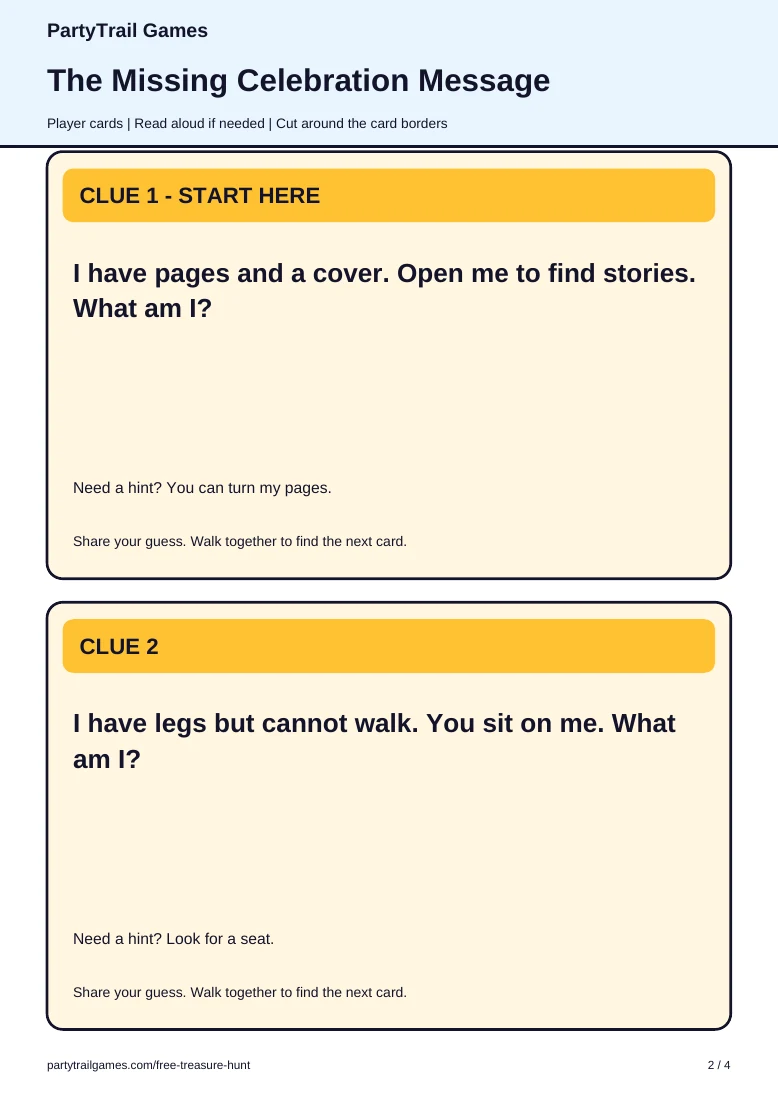
No. These five activity plans and the six sample station questions can be copied from this article. The free mini hunt is also available without signup. A personalised full PartyTrail pack is a separate purchase.
Make a mission for your whole group
Choose a theme, set the real number of players and inspect the locked preview before buying your printable treasure hunt.
Build a group treasure huntWant a short activity first? Try the free five-clue mini hunt