Free classroom activity
Fractions treasure hunt activities for ages 8–10
Eight maths puzzles, a downloadable card set and practical ways to discuss each method.
A fractions treasure hunt works best when pupils have to explain a method, not simply collect answers. These eight original paper challenges practise equal parts, fractions of quantities, equivalence and simple calculations.
Use the easier cards as a starting point and the comparison and remainder cards as extensions. Ages eight to ten are a planning guide, not a curriculum guarantee: choose tasks that follow what your pupils have already been taught.
1. Download eight cards and worked answers
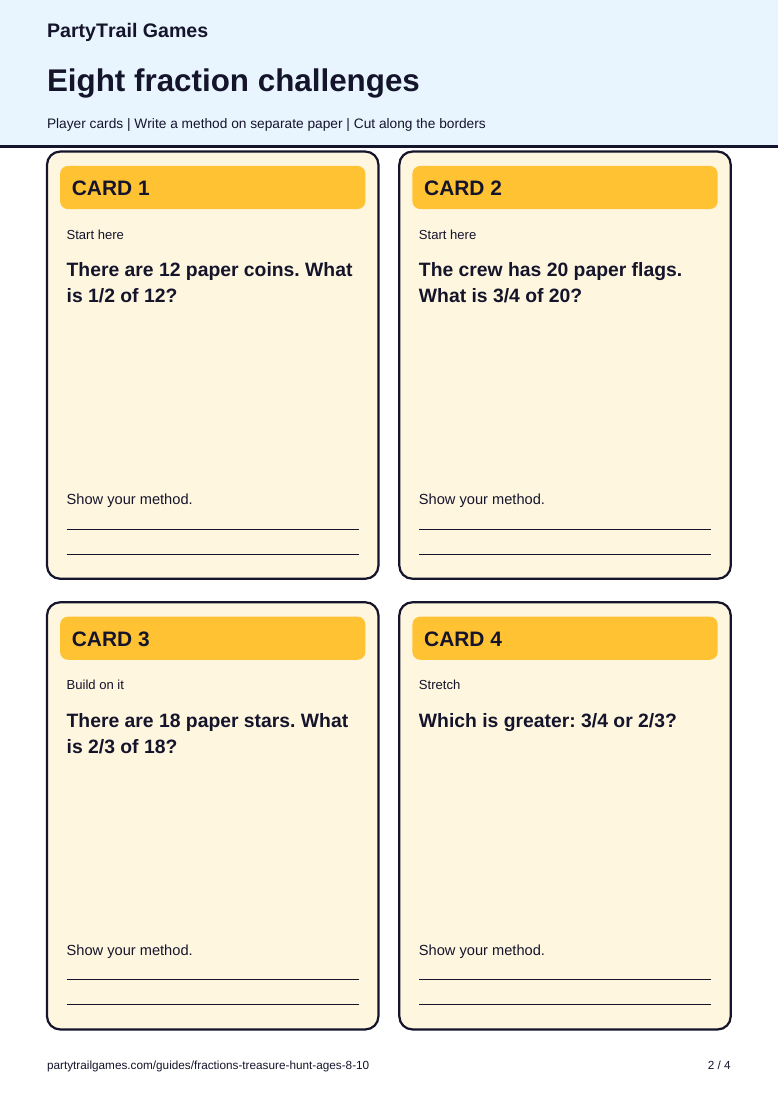
The four-page free PDF contains an adult plan, eight cut-out question cards and a separate worked answer page. No signup is needed. You can also copy the questions below onto paper.
2. Eight puzzles with worked answers
Card 1: Find a half (start here)
There are 12 paper coins. What is 1/2 of 12?
Show answer and explanation
6
Split 12 into two equal groups: 12 divided by 2 is 6.
Card 2: Find three quarters (start here)
The crew has 20 paper flags. What is 3/4 of 20?
Show answer and explanation
15
One quarter is 20 divided by 4 = 5. Three quarters is 3 times 5 = 15.
Card 3: Find two thirds (build on it)
There are 18 paper stars. What is 2/3 of 18?
Show answer and explanation
12
One third is 18 divided by 3 = 6. Two thirds is 2 times 6 = 12.
Card 4: Compare fractions (stretch)
Which is greater: 3/4 or 2/3?
Show answer and explanation
3/4
Use equal-sized wholes. In twelfths, 3/4 = 9/12 and 2/3 = 8/12. Nine twelfths is greater.
Card 5: Read equal parts (start here)
A bar has eight equal parts. Three parts are shaded. What fraction is shaded?
Show answer and explanation
3/8
The denominator 8 counts all the equal parts; the numerator 3 counts the shaded parts.
Card 6: Add like fractions (build on it)
Find 1/4 + 2/4.
Show answer and explanation
3/4
The parts are the same size. One quarter plus two quarters is three quarters; the denominator stays 4.
Card 7: Make an equivalent fraction (build on it)
Complete the missing numerator: 2/5 = ?/10.
Show answer and explanation
4
Multiply both numerator and denominator by 2: 2/5 = 4/10. The missing numerator is 4.
Card 8: Find what remains (stretch)
A whole paper strip has eight equal parts. Three eighths are removed. What fraction remains?
Show answer and explanation
5/8
One whole is 8/8. Subtract 3/8 from 8/8 to get 5/8.
For the shaded-bar task, draw eight equal boxes in one row and shade three. For comparing 3/4 with 2/3, use two equal-length strips. Splitting both strips into twelfths makes the difference visible.
3. Set up numbered stations
- Choose the cards that match your teaching and keep the answers with the adult.
- Place cards at clearly numbered, reachable stations. Put pairs at different starting stations to reduce queues.
- Give each pair paper and a pencil. They record the card number, answer and method.
- After an adult checks a response, pupils move to the next numbered station. At station 8 they loop back to station 1 if they still have cards to visit.
- Finish with one shared explanation and a question pupils found interesting.
One partner can read while the other draws or calculates; swap at the next station. For a quieter version, leave pupils seated and pass the cards between pairs. There is no need to hide cards or to use individual pupil names.
4. Leave time for explanation
| Part | Planning estimate | What pupils do |
|---|---|---|
| Introduce | 5 minutes | Revisit numerator, denominator and equal parts with a paper strip. |
| Solve and explain | 15-20 minutes | Visit selected stations in pairs and record a method. |
| Discuss | 5-10 minutes | Compare strategies, correct a misconception and explain a choice. |
For pupils who need an easier entry, begin with cards 1 and 5 and use counters or paper strips. Introduce cards 4 and 8 only when pupils are ready for the comparison or subtraction involved.
5. Questions that reveal the thinking
- What is the whole in this question?
- Are the parts equal in size?
- What does the denominator tell us?
- Can you show the same amount using a different fraction?
- How would you check the answer using a diagram?
When adding 1/4 and 2/4, do not add the denominators. The pieces remain quarters: one quarter plus two quarters makes three quarters. Ask pupils to draw the pieces if the calculation seems abstract.
6. Extend the activity into a story
Invite pairs to invent a ninth card and provide a worked answer. Another pair checks whether the question has enough information and whether its answer is correct. The class can then tell a short mission story connecting the stations.
Common questions
Are all eight cards suitable for every eight-year-old?
No. Select cards using pupils’ prior learning. Start with equal parts and simple quantities; equivalence, comparison and remainders can be extensions.
Do I need a printer or special equipment?
You can copy the questions onto paper. Paper strips, counters, pencils and scrap paper are enough for the suggested methods.
Do pupils use the numerical answers to find the next station?
No. This standalone activity uses numbered stations and an adult checkpoint. Pupils move to the next numbered station after their method has been checked.
Choose a personalised classroom adventure
Explore the teacher options and inspect a game preview with your chosen age, theme and learning focus.
Explore classroom gamesWant a short activity first? Try the free five-clue mini hunt