Family activities
5 screen-free after-school activities in 15 minutes
Five short activities to choose from after a snack and a rest, using paper and familiar household objects.
After school, a child may want food, a chat or a rest before another organised activity. Offer a choice rather than treating the afternoon as a second school day. “Would you like a mystery bag or a little map challenge?” is enough to start.
Each idea below has a roughly 15-minute version, including a short tidy-up. Preparation and playing times are estimates. These activities suit ages 5–12 with the variations shown; none requires a purchase or a child to use a screen.
Choose by the kind of afternoon you have
| Today feels… | Try this | A natural stopping point |
|---|---|---|
| Quiet and tired | Mystery bag detectives | Three objects identified. |
| Talkative | A sound-effects story | One beginning, problem and ending. |
| Ready to make something | Design a paper playground | One design explained. |
| Ready to solve | Map message or mini clue trail | One route completed. |
Five activities with a clear finish
- Ages
- 5–12
- Group
- One child and an adult, or siblings
- Preparation
- 2 minutes
- Playing time
- 10–13 minutes
Materials: A cloth bag and three familiar objects without sharp edges.
How to play
- Put an object in the bag without showing it.
- Let the player describe how it feels before naming it; no peeking is needed.
- Reveal it and compare the description with what you can see. Swap the person choosing objects.
Make it easier
Show the possible objects first.
Add a challenge
Give a description that could fit two objects, then ask one question to distinguish them.
Talk about it: Which clue told you the most?
- Ages
- 6–12; adult reading for younger children
- Group
- 1–4
- Preparation
- 2 minutes
- Playing time
- 12 minutes
Materials: Paper and pencil.
How to play
- Draw a 3 by 3 map labelled A–C across and 1–3 from bottom to top.
- Put a star at A1, a tree at B2 and a bridge at C3.
- Read a route from the star. The player draws it and adds the missing destination, then writes a new route for you.
Make it easier
Use a row of three places and point as you move.
Add a challenge
Find two different routes with the same start and finish.
Talk about it: Why do the row and column labels remove ambiguity?
Show answer and explanation
From A1, one square east and one north reaches B2, the tree. East changes the column A to B; north changes row 1 to row 2.
- Ages
- 5–12
- Group
- 1–4
- Preparation
- 2 minutes
- Playing time
- 10–13 minutes
Materials: Scrap paper and pencils.
How to play
- Draw a tiny playground with somewhere to climb in the imaginary design, somewhere to rest and a clear path between them.
- Ask the designer to explain how visitors enter and move around.
- Add one new requirement, such as space for a wheelchair to reach the rest area, and revise the drawing.
Make it easier
Choose and draw three features together.
Add a challenge
Use a simple grid and limit the available squares.
Talk about it: Which change made the design easier for someone else to use?
- Ages
- 5–12
- Group
- 2–4
- Preparation
- 1 minute
- Playing time
- 10–14 minutes
Materials: Paper for optional drawings; voices or gentle tabletop taps.
How to play
- Choose three sounds: rain, a creaking door and footsteps.
- One person tells a short story while the others add the agreed sounds.
- Swap storyteller and sound makers. End by giving the story a title.
Make it easier
Tell the story together one sentence at a time.
Add a challenge
Use the same sounds in a completely different setting.
Talk about it: How did a sound change what you imagined?
- Ages
- 5–12
- Group
- 1–4 with an adult
- Preparation
- 3–5 minutes
- Playing time
- 8–12 minutes
Materials: Three paper clues and a finishing note.
How to play
- Choose a low shelf, a reachable chair and a table.
- Hand over a clue to the shelf; put the chair clue there and the table clue beside the chair.
- Finish at the table with a note choosing the next family activity. Rotate reader and finder if more than one child plays.
Make it easier
Draw the three places as picture clues.
Add a challenge
Add a short puzzle before each location is revealed.
Talk about it: How did you know which place the clue meant?
A ready-to-copy mini-trail puzzle
Before the next envelope
I have 14 paper stars. I put the same number in two envelopes. How many stars are in each?
Show answer and explanation
Seven stars.
14 split into two equal groups is 7 in each. Check with 7 + 7 = 14. Draw stars or use counters if the division symbol is unfamiliar.
After the child explains the answer, hand over the location clue. This keeps a difficult calculation from blocking access to the next card. A hint is part of the game, not a penalty.
Leave one small invitation for another day
Keep the map or story title if the child wants to return to it. Tomorrow, change the route, swap an object or ask a new design question. Reusing a familiar structure can make preparation easier without repeating every answer.
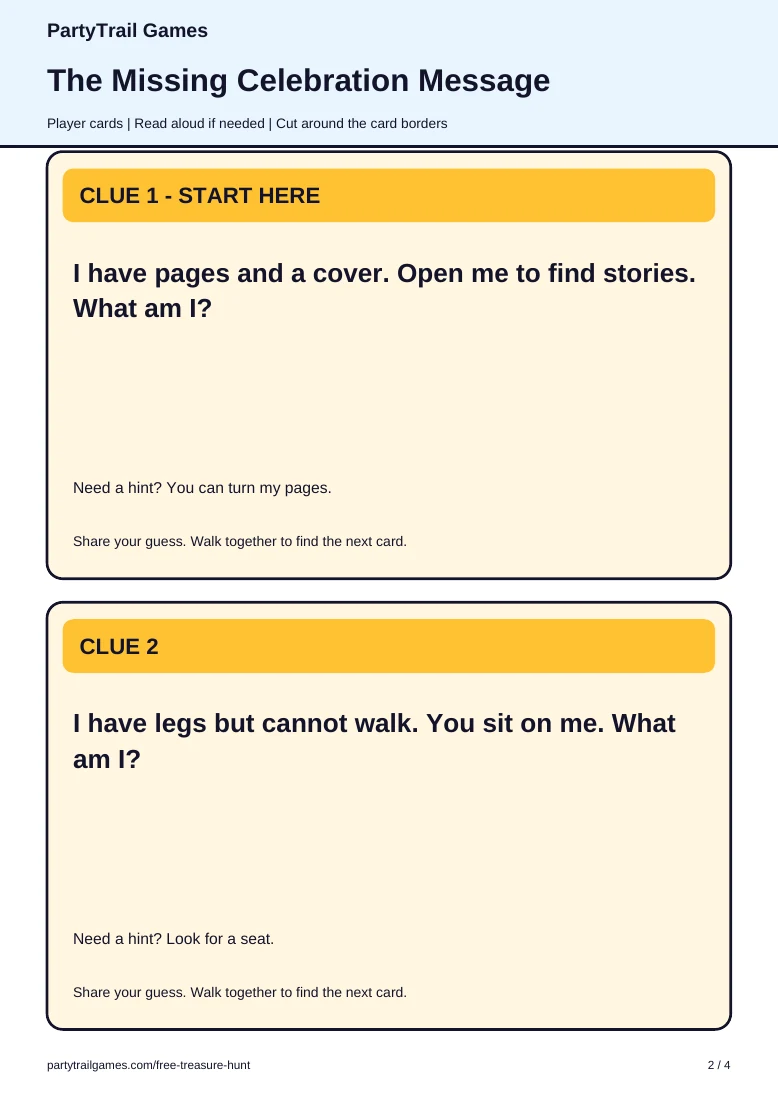
For a longer afternoon, the free five-clue mini hunt includes a placement guide and finish note. It is a separate printable activity; printing and hiding the cards takes adult preparation. A personalised full game is a longer option, so check its estimated duration instead of expecting it to fit this 15-minute slot.
Common questions
Do these need to be educational every day?
No. The aim can simply be spending a little time together. You can discuss a method or new word when the child is interested, without making every activity a lesson.
Can a child play independently?
Drawing and designing can be independent if the materials and space are appropriate. Mystery objects, hidden routes and younger players need an adult’s setup and supervision.
What if we only have five minutes?
Try one mystery object, one map instruction or a three-sentence story. Stop at a satisfying point instead of rushing through the whole plan.
Keep a mini adventure ready
The free five-clue printable has a short route, answers and an adult placement guide. You can download it without an account.
Get the free mini huntWant a short activity first? Try the free five-clue mini hunt