Family activities
12 rainy-day activities for kids aged 5–12
Clue trails, paper bridges, storytelling and nine more indoor ideas using everyday supplies.
A rainy afternoon is a chance to build something, invent a story or solve a small mystery together. Choose one activity that fits the children’s energy and the supplies you already have. You can finish after one good game or save another idea for later.
These 12 indoor family activities suit different interests across ages 5–12. Each includes materials, a starting plan and ways to adjust the challenge. An adult can join a single child, siblings can work together, or a small group can share the jobs.
Choose an activity for today
For a quick start, try the story relay, memory tray or sock targets. For making and problem-solving, choose the paper bridge, cardboard town or board game. A clue trail works well when you have time to prepare the route before inviting the children to search.
Use a clear table or floor area, keep walkways open and choose materials suitable for everyone present, including younger siblings. An adult can cut packaging in advance. Keep the activity at a comfortable height and adapt searching or throwing to seated participation when useful.
1. Make a family clue trail
- Ages
- 5–12, with reading help as needed
- Group
- One child and an adult, or a small family team
- Preparation
- 10–15 minutes for a short handmade route
- Playing time
- 15–30 minutes for the handmade route
Materials: Five paper cards, a pencil, optional envelopes and a finishing note.
How to play
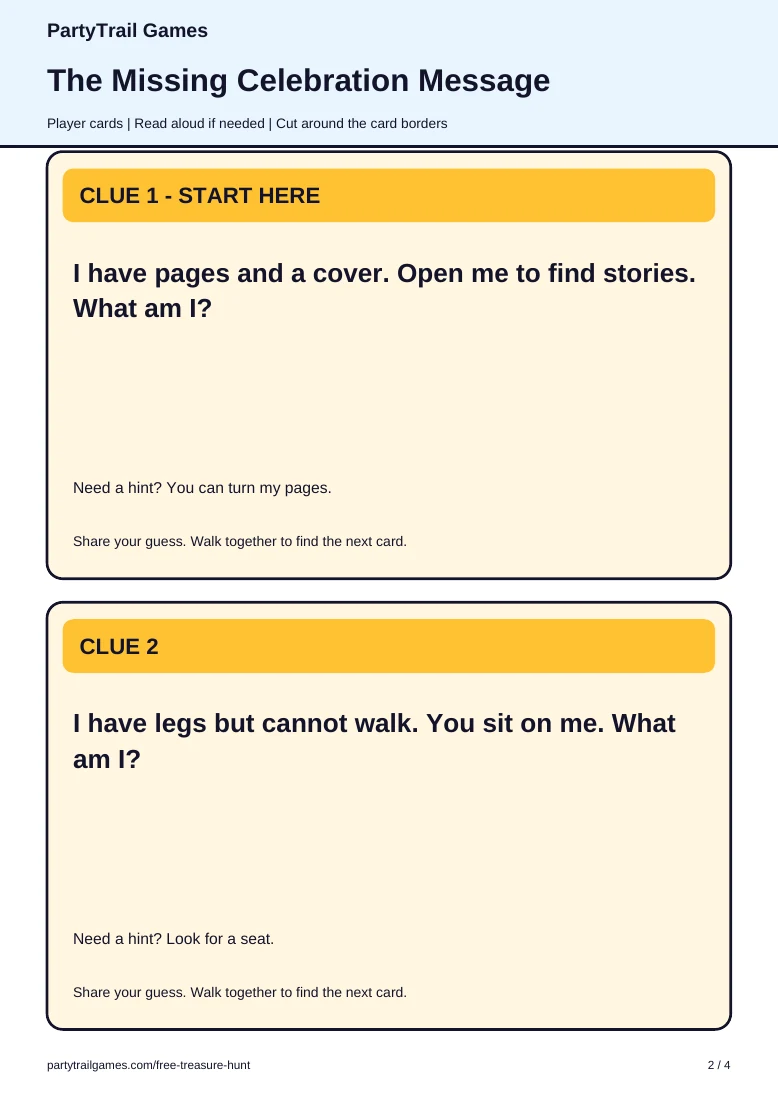
- Choose five reachable places, such as a low bookshelf, coat hook, shoe rack, sofa and table. Write down the route before hiding anything.
- Give the first card to the team. A starting clue could read: “Find the low shelf where our stories stand in a row.” Put the next card at the bookshelf and continue the sequence.
- Alternate the reader, finder and checker. End with a shared congratulatory message or a choice of the next family activity.
Make it easier
Draw the hiding places and read the words aloud. An adult can bring cards to a child solving from one spot.
Add a challenge
Add a small calculation or code before revealing the next location, and ask the team to explain its answer.
Talk about it: What helped you work out where the first card was pointing?
Show answer and explanation
The bookshelf. “Stories” suggests books, and “low shelf” identifies the reachable place. Add another detail if your home has several bookcases.
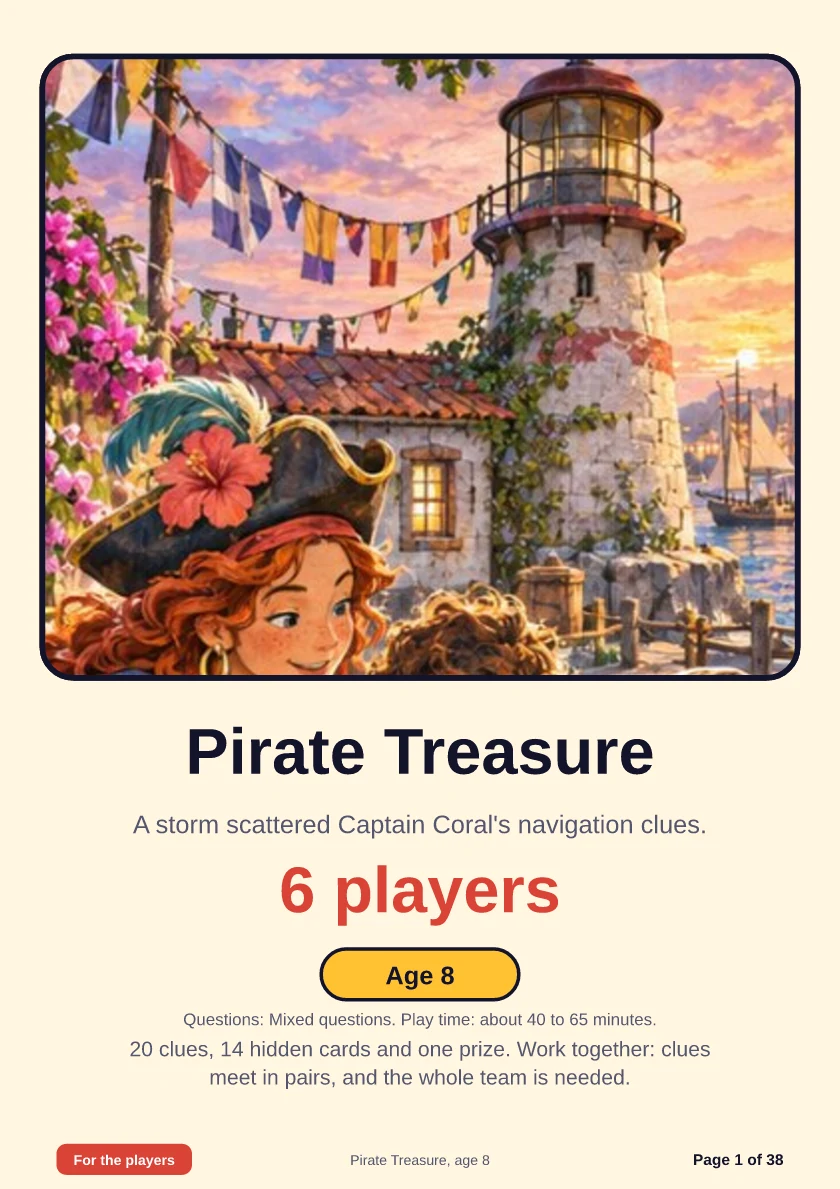
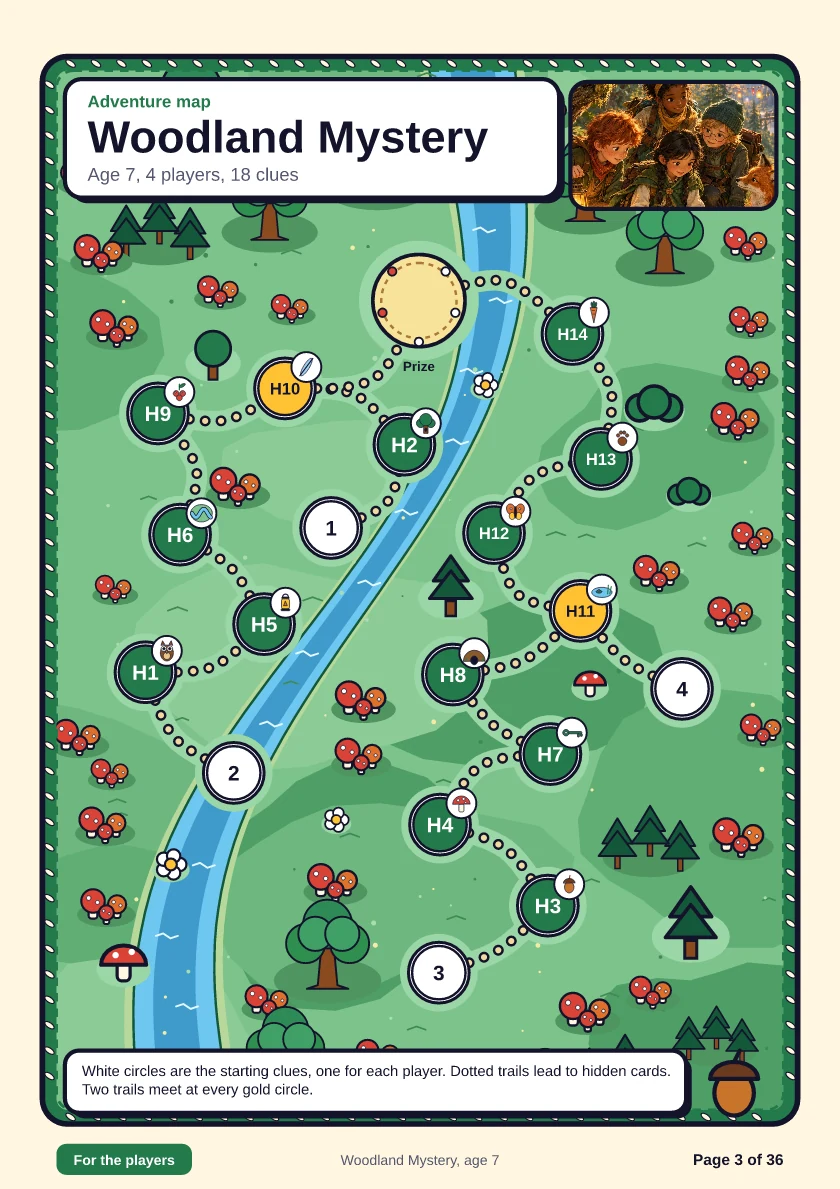
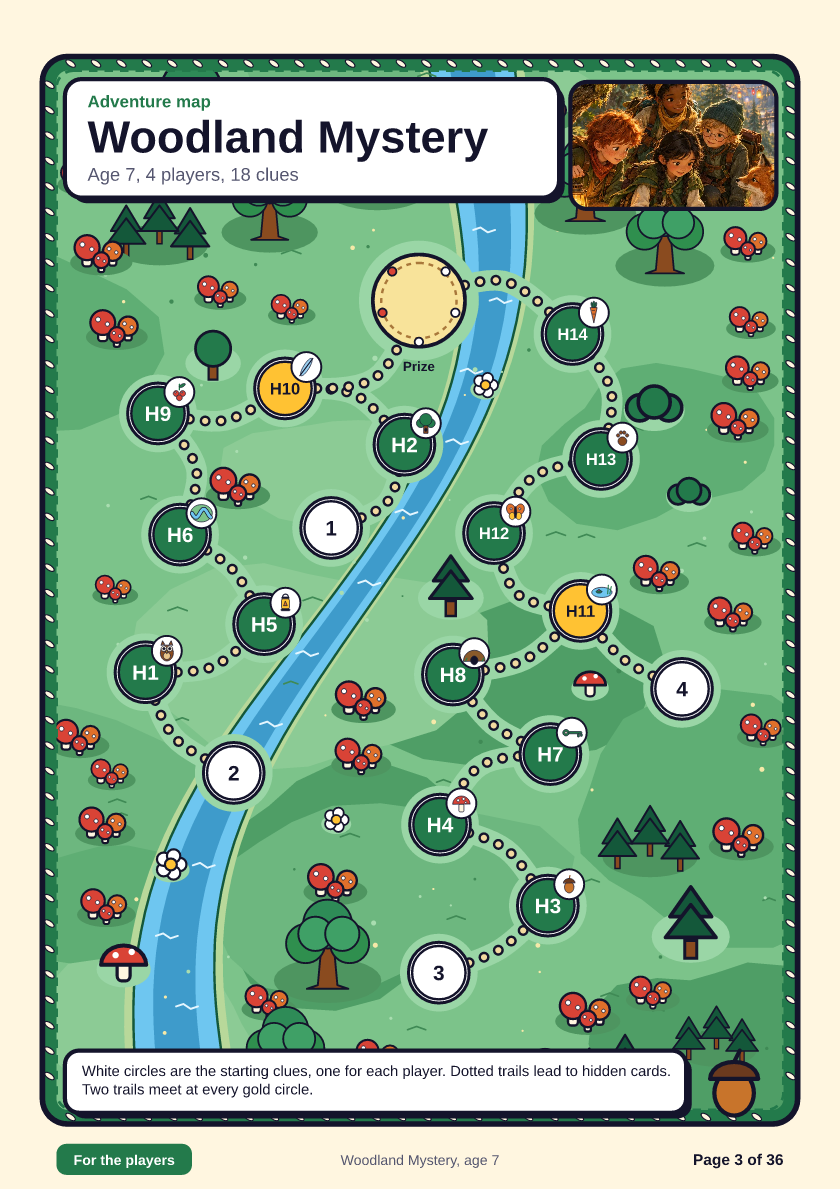
For a personalised version, our PartyTrail games let you choose the age, players, theme and available hiding places. Preview the pack and follow its own adult setup map. Its play-time estimate applies to that generated game; it can be longer than the short handmade trail above.
2. Build and test a paper bridge
- Ages
- 5–12
- Group
- One builder or pairs
- Preparation
- 3 minutes
- Playing time
- 15–25 minutes
Materials: Two sheets of similar paper, two closed books and one small eraser.
How to play
- Put the books on a table with a small gap between them, about 10 centimetres. Lay one sheet across the gap.
- Try placing the eraser gently at the middle. Record whether the bridge holds it, bends or touches the table.
- Make concertina folds running along the length of the second sheet, so the folded paper still spans the gap. Bridge the same gap and use the same eraser. Compare the results, then try one redesign.
Make it easier
An adult makes the folds while the child places the eraser and describes what happens.
Add a challenge
Measure the bend or change the gap in small steps, keeping the paper and load the same for each comparison.
Talk about it: Which parts did you keep the same so that comparing the two designs was useful?
3. Design a cardboard town
- Ages
- 5–12
- Group
- One child or a family design team
- Preparation
- 5–10 minutes, including adult cutting
- Playing time
- 25–45 minutes
Materials: Clean empty boxes, paper, pencils and tape.
How to play
- Choose a few buildings your town needs: homes, a library, a school or a station. Give each person one building to design.
- Arrange the buildings on a sheet of paper and draw roads and walking routes between them.
- Introduce a challenge: a character needs to get from home to the library. Improve the layout so that the route is easy to explain.
Make it easier
Use three boxes and draw a single route together.
Add a challenge
Add a river, bridge or delivery route, then explain how the town changes when one road closes.
Talk about it: Why did you put those two buildings near each other?
4. Open a living-room museum
- Ages
- 5–12
- Group
- One curator and a visitor, or a small team
- Preparation
- 5 minutes
- Playing time
- 20–35 minutes
Materials: Four or five safe toys, drawings or everyday objects, plus paper labels.
How to play
- Choose a theme, such as things that move, interesting shapes or favourite story characters. Ask before borrowing anyone’s belongings.
- Arrange the exhibits on a reachable surface. Give each one a title and a sentence explaining why it belongs.
- Invite another family member on a guided tour. Let the visitor ask questions, then swap curator and visitor roles.
Make it easier
Dictate the labels to an adult or draw a picture beside each object.
Add a challenge
Sort the same exhibits in two different ways and explain both choices.
Talk about it: Which exhibit would you choose to introduce the whole collection, and why?
5. Tell a story one sentence at a time
- Ages
- 5–12
- Group
- Two or more storytellers
- Preparation
- 1 minute
- Playing time
- 10–20 minutes
Materials: Your voices; paper and pencils are optional.
How to play
- Start with a shared sentence: “A tiny robot arrived at the door carrying an empty envelope.”
- Take turns adding one sentence. Each new sentence should connect to something already in the story.
- After everyone has had a few turns, agree on an ending and draw the most surprising moment.
Make it easier
Offer two choices when someone gets stuck: “Does the robot go to the garden or the library?”
Add a challenge
Introduce three words that the group must use meaningfully before the ending.
Talk about it: Which sentence changed the direction of the story?
6. Become memory detectives
- Ages
- 5–12
- Group
- Pairs or a small group
- Preparation
- 2 minutes
- Playing time
- 10–15 minutes
Materials: A tray, a cloth and six familiar objects such as a pencil, spoon, sock, book, toy and paper shape.
How to play
- Arrange the objects and let everyone study them. Name or describe them aloud if that helps the group.
- Cover the tray while one person removes or moves an object. Uncover it and let everyone think before answering.
- Ask for the evidence: which object is missing, or what changed about its position? Swap the person arranging the tray.
Make it easier
Use three objects and change only one thing.
Add a challenge
Use eight objects or change one position while keeping every object present.
Talk about it: Did you remember objects by their names, their positions or a pattern?
7. Set up a gentle sock-target game
- Ages
- 5–12
- Group
- One player or a family team
- Preparation
- 2 minutes
- Playing time
- 10–20 minutes
Materials: Rolled socks, a large basket and a paper score sheet.
How to play
- Place the basket in a clear floor area away from breakable objects. Choose a comfortable throwing position and use gentle underarm throws.
- Give everyone three throws. Count the socks landing in the basket, then collect them before the next turn.
- Set a shared team target for the next round. Change the distance to suit each player.
Make it easier
Bring the basket closer, enlarge the target or roll the socks towards it from a seated position.
Add a challenge
Compare the total from two rounds and calculate how many more hits the team needs to reach its chosen target.
Talk about it: If the team scores 4 hits and its target is 7, how many more hits are needed?
Show answer and explanation
3 more hits, because 7 − 4 = 3. Use seven drawn circles and fill four to show the gap.
8. Let the children create the family quiz
- Ages
- 5–12
- Group
- Pairs or a small family group
- Preparation
- 3 minutes
- Playing time
- 15–25 minutes
Materials: Paper, pencils and optional books for checking facts.
How to play
- Each quiz maker writes or draws two questions and puts the answers on a separate sheet.
- Include a question that asks for a reason. Try: “Which has more corners: two separate triangles or one rectangle?”
- Take turns asking and explaining. Check any uncertain factual answer together before counting it as correct.
Make it easier
Use picture questions and let an adult write the answers.
Add a challenge
Ask quiz makers to include a useful hint and explain how to check their answer.
Talk about it: How many corners are there in two separate triangles, compared with one rectangle?
Show answer and explanation
Two separate triangles have 6 corners altogether; a rectangle has 4. The triangles have 2 more corners. Draw the shapes and mark each corner.
9. Draw a map and guide a paper explorer
- Ages
- 5–12
- Group
- One map maker and one navigator
- Preparation
- 3 minutes
- Playing time
- 15–25 minutes
Materials: Paper, pencils and a paper character.
How to play
- Draw a simple imaginary room with a door, table and bookshelf. Add a start dot and a treasure star.
- Make a key for three symbols. Use the key to explain the map to your partner.
- Describe a route for the paper explorer to follow. Swap maps and check whether the instructions reach the star.
Make it easier
Use two landmarks and trace the route with a finger.
Add a challenge
Add a blocked path and revise the directions without moving the treasure.
Talk about it: Which landmark made your directions easiest to follow?
10. Put on a sock-puppet mini show
- Ages
- 5–12
- Group
- Two or more performers and storytellers
- Preparation
- 5 minutes
- Playing time
- 20–35 minutes
Materials: Clean socks, paper props and a tabletop stage; decorations are optional.
How to play
- Give each puppet a name, a goal and one problem. For example, a dragon has lost the instructions for its new flying machine.
- Agree on three scenes: meeting the problem, trying an idea and finding a solution.
- Perform the short show, then invite the audience to suggest a different ending.
Make it easier
An adult narrates while children move or voice the puppets.
Add a challenge
Tell the same event from two characters’ points of view.
Talk about it: Did both characters want the same thing? What helped them agree?
11. Invent a small board game
- Ages
- 6–12, with an adult for younger players
- Group
- Two to four designers and players
- Preparation
- 5 minutes
- Playing time
- 25–40 minutes
Materials: Paper, pencils, large playing pieces and six paper cards marked 1, 2, 3, 1, 2, 3.
How to play
- Draw a path of ten spaces with a start and finish. Add two spaces that ask a player to invent a riddle or give another player a helpful clue.
- Shuffle the number cards. Take turns drawing a card and moving that many spaces; return and reshuffle the cards when the stack is used.
- Decide how the finish works before playing: reaching or passing it is a simple rule. Play once, then change one rule that felt confusing.
Make it easier
Draw six spaces and let everyone move one shared piece towards the finish.
Add a challenge
Compare two possible rules and explain which gives players more useful choices.
Talk about it: Which rule needed the clearest explanation when you first played?
12. Make a paper family time capsule
- Ages
- 5–12
- Group
- One child and an adult, or the whole family
- Preparation
- 3 minutes
- Playing time
- 15–30 minutes
Materials: Paper, pencils and an envelope or empty box.
How to play
- Ask everyone to draw or write three things: something they enjoy now, something they are learning and a question for their future self.
- Add a shared page describing today’s favourite activity. Include the date so you can recognise the moment later.
- Put the pages in the envelope and agree on a future family occasion to open it. Keep it somewhere the adults will remember.
Make it easier
Use pictures or dictate the words to someone else.
Add a challenge
Write a prediction and explain what makes it plausible, then leave space to compare it with what eventually happens.
Talk about it: Which of today’s details do you think you will most enjoy remembering?
Keep the next choice simple
Finish by asking each child which part they would repeat and what they would change. Save the materials in a labelled envelope or box if you want a quick start next time. For mixed ages, give younger children a concrete job and older children a reason to explain their thinking.
Common questions
Which activity can we start with almost no preparation?
The one-sentence story relay takes about a minute to begin. The memory tray and sock targets are also quick if the listed materials are already to hand. The times are estimates; adapt them to your household.
What works for children of different ages?
Choose a shared project such as the cardboard town, museum or clue trail, then give everyone a useful job. A younger child might choose or find an object while an older child writes a label or explains a rule. Reading confidence matters alongside age.
Do these ideas require a printer or a purchase?
The handmade activities can be done without a printer using the listed household materials. A personalised PartyTrail game is an optional printable alternative for the clue trail; check its preview, price and page count before choosing it.
Make the next family activity an adventure
Choose a story, the age, players and places you have, then preview your own PartyTrail game.
Create a family treasure huntWant a short activity first? Try the free five-clue mini hunt