At home
How to organise an indoor treasure hunt for kids
Five clues you can use today, a simple setup plan and ways to include different ages.
A good indoor treasure hunt gives children a clear first step, small discoveries along the way and a finish they can share. A few accessible hiding places and readable clues are enough to begin.
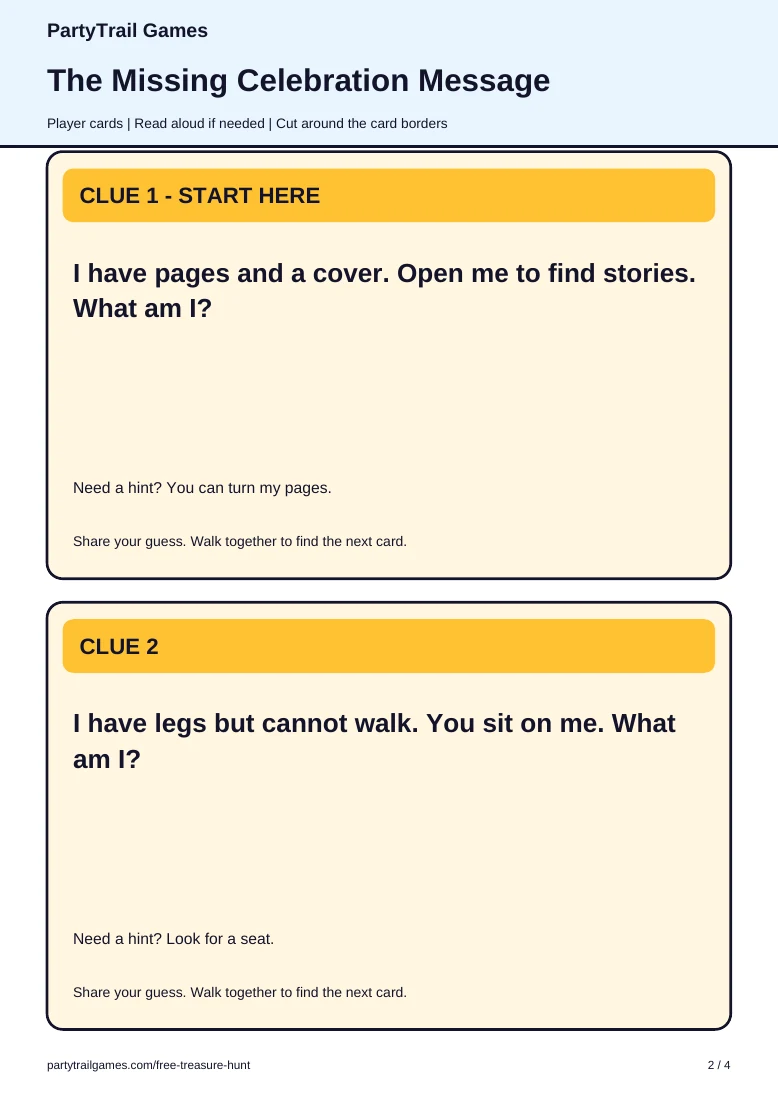
This guide includes a five-clue trail you can copy onto paper, suggestions for different ages and actual pages from a PartyTrail demo. Choose the version that fits your space and the children who will play.
1. Gather a small set of supplies
For a handmade trail, gather five pieces of paper, a pencil, envelopes if you have them and a small shared prize or a finishing message. If you use a printable pack, check its page list before printing so you know which sheets belong to the players and which are for the adult.
- Decide how many children will play and whether an adult will read the clues aloud.
- Choose one room or a small group of rooms as the play area.
- Pick a finish: a treasure box, certificates, a shared activity or a congratulatory note.
- Keep a spare copy of the route and answers with the adult.
The finish does not have to be an expensive gift. An envelope announcing the next party activity can be the treasure. Decide how it will be shared before the hunt starts.
2. Choose hiding places children can reach
A low bookshelf, a coat peg, a shoe rack, a sofa cushion and a dining table make a useful starting set. Use the outside of a container or a visible envelope beside a place when opening or moving something would be awkward.
Walk the route yourself. Each clue should point to one place that exists in your home. If you have several bookcases, add a helpful detail such as “the low bookcase beside the sofa”. Tell children which rooms and objects are part of the game.
Keep the play area away from stairs, heaters, appliances, medicines and cleaning products. Cards can sit beside furniture; the hunt should never depend on climbing or moving something heavy.
3. Copy this five-clue mini treasure hunt
Give children the start card. Put clue 2 at the bookshelf, clue 3 at the coat peg, clue 4 at the shoe rack and clue 5 by the sofa. Put the finishing envelope at the dining table. Change any location that your home does not have before you hide the cards.
Start card
Your next clue waits where books stand in a row. Find the low shelf where your stories go.
Show answer and explanation
The bookshelf.
Hide clue 2 at the agreed low bookshelf.
Clue 2
When a coat comes home from a rainy-day trip, where does it hang from its collar or zip?
Show answer and explanation
The coat peg or hook.
Hide clue 3 at a reachable coat peg. Use “coat hook” on the card if that is your household’s usual name.
Clue 3
Two by two, our shoes wait here. Find their rack; the next clue is near.
Show answer and explanation
The shoe rack.
Hide clue 4 beside the shoe rack. Give the rack an extra identifying detail if necessary.
Clue 4
Find the sofa where you sit and rest. Beside its cushion is your next small quest.
Show answer and explanation
The sofa cushion.
Put clue 5 beside an easy-to-reach cushion; nothing heavy needs to be lifted.
Clue 5
Your team has worked together well. At the table where you eat, the final envelope has a tale to tell.
Show answer and explanation
The dining table.
Place the finishing envelope where everyone can reach or see it.
4. Adjust the challenge for the children playing
| Group | A useful adjustment |
|---|---|
| Ages 5–6 | Read the clue aloud, use familiar place names and let children point to the answer. |
| Ages 7–8 | Add one short calculation, word puzzle or picture pattern before the next location. |
| Ages 9–12 | Use two connected facts, a small code or a clue that asks children to explain their reasoning. |
| Mixed ages | Pair a reader with a finder, then swap roles. An older child can explain a method while a younger child checks the picture or counts objects. |
For example, a card can ask “There are three envelopes with two paper coins in each. How many coins altogether?” The answer is six: 2 + 2 + 2. The adult can give the next location after the team explains the answer. Agree that rule before starting.
5. Give everyone a job, then test the route
Try three rotating roles: the reader shares the clue, the solver suggests an answer and the checker explains why it works. A finder collects the next envelope. Children can combine roles in a small group.
Before guests arrive, follow the complete route with your answer copy. Check that every envelope is in place and that the final clue leads to the finish. During play, offer one hint at a time: first point to a useful detail, then help with the method.
- Begin with the play boundary and a “walk between clues” rule.
- Read the opening story or explain the shared mission.
- Pause if one child is doing all the reading or searching; rotate the roles.
- Finish by asking everyone to name one clue they helped solve.
What a printable treasure hunt looks like
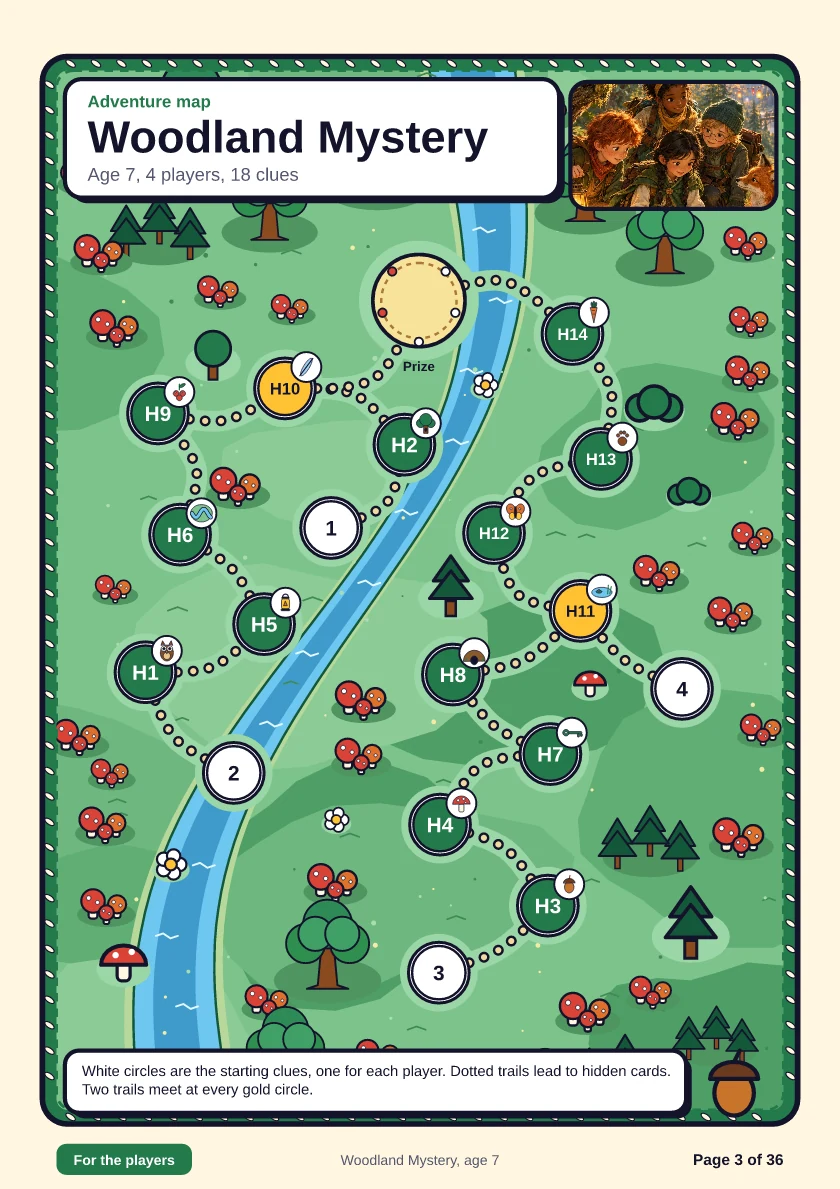
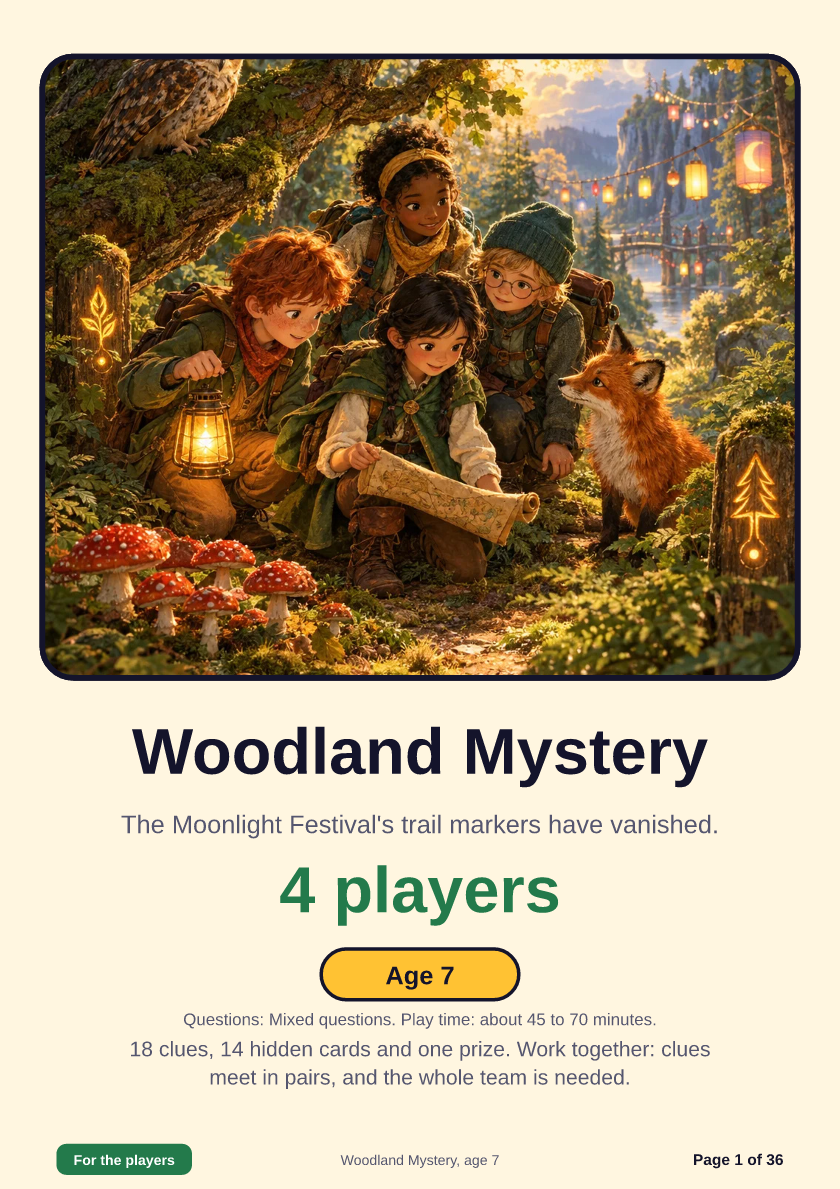
These are actual exported pages from a Woodland Mystery demo for four players aged seven. The adventure map shows how discoveries connect. The adult pack includes the placement information needed to set up that particular game.
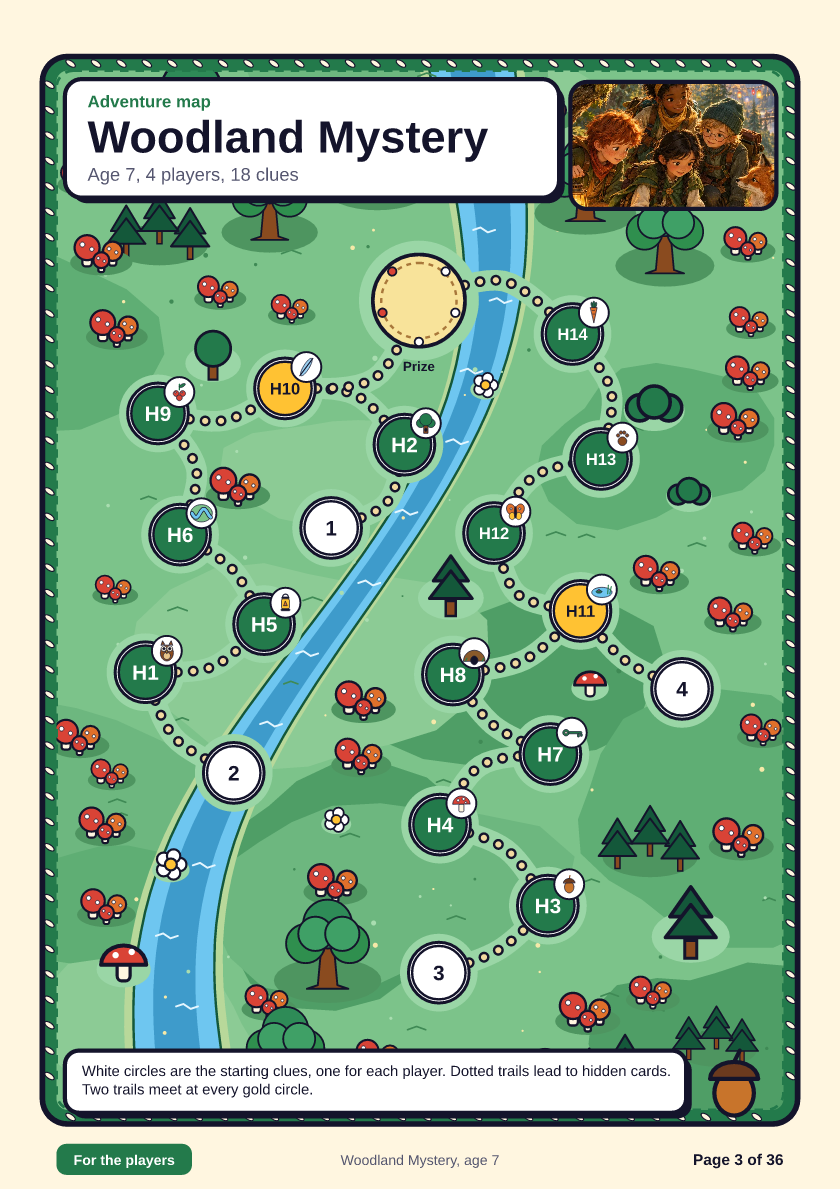
In PartyTrail, choose the age, players, question focus and hiding places available in your space. Preview the game before buying or using your free-game allowance. Your printable pack follows those choices.
Common questions
Can I run a treasure hunt in one room?
Yes. Choose distinct places in that room and put envelopes beside them. For a printable game, select the real places you have and check the resulting preview and adult map.
How long should an indoor treasure hunt last?
Choose a length that suits the children’s concentration and the rest of the day. A handmade five-clue trail can be a short activity; a generated pack can contain substantially more challenges. Check the game’s play-time estimate and leave time for the introduction and finish.
Do all the children have to read independently?
No. An adult or another player can read aloud. Give non-readers meaningful roles such as counting, matching pictures, checking an answer or finding an envelope.
Make a trail for your space
Choose a theme and the hiding places you actually have, then preview your own printable adventure.
Build an indoor treasure huntWant a short activity first? Try the free five-clue mini hunt