Birthday parties
Pirate birthday party games you can print at home
Turn a few printed pages into Captain Coral’s next adventure, with puzzles and a party plan.
A pirate birthday party needs a mission children can understand: something has gone missing, every crew member can help and the discoveries lead to a shared treasure. Printed clues give that story something children can hold, solve and find.
Here is a practical plan built around Captain Coral’s Pirate Treasure adventure, plus three paper puzzles you can use as warm-ups. Costumes and extra props are optional; the teamwork is the centre of the game.
1. Give the crew a clear mission
In PartyTrail’s Pirate Treasure story, a storm scatters Captain Coral’s navigation clues. The crew helps recover compass fragments and piece together the route to her thank-you treasure. Introduce that goal before handing out the first cards.
Explain what counts as a discovery and where it should go. For a generated game, use the pack’s own opening, clue directions and map. The story and printed route are designed to work together.
2. Prepare your pages and hiding places
- Choose the number of players and an age setting suited to the group.
- Select hiding places you genuinely have, such as a low bookshelf, shoe rack or table.
- Preview the pack. Separate the children’s pages from the adult answers and placement guide.
- Print at the paper size you selected. Use ink-saving mode if that suits your printer.
- Label envelopes if you are using them, then place the cards using the adult map.
- Keep the final treasure and the adult answer pages with the organiser until the setup is complete.
The preview tells you what this particular game contains. Page counts and route details can change with the number of players and your settings, so use your own pack as the checklist.
Walk the route once before the party. Keep clues at a comfortable height and inside the agreed play area. Place them where children can collect a card without climbing, opening appliances or moving furniture.
3. Try three pirate puzzle warm-ups
These are original examples for this guide. Put them on a separate warm-up sheet or read them aloud while the crew gathers. They do not replace numbered cards in a generated PartyTrail pack.
Counting treasure
Coral has three envelopes. Each holds four paper coins. How many paper coins are there altogether?
Show answer and explanation
12 paper coins.
Four coins in each of three groups gives 4 + 4 + 4 = 12. Children can draw three envelopes and count their coins.
Compass pattern
A pointer makes a quarter-turn clockwise each time: North, East, South, West. Where does it point next?
Show answer and explanation
North.
The four named points repeat in the same order after one complete turn. A paper compass makes the pattern easier to check.
Secret crew word
Use the key 1 = A, 2 = B, 3 = C and so on. Decode 3 – 18 – 5 – 23.
Show answer and explanation
CREW.
3 is C, 18 is R, 5 is E and 23 is W. Give children an alphabet-number strip so the rule is available to everyone.
Choose one warm-up that fits the children. A five-year-old may enjoy drawing and counting the coins with an adult; a confident older reader might explain the code to the crew. One well-chosen puzzle is enough to introduce cooperation.
4. Leave room for the story and the finish
| Part of the adventure | Example time | What happens |
|---|---|---|
| Crew briefing | 5 minutes | Introduce Captain Coral, the play area and the crew roles. |
| Main trail | 25 minutes | Find and solve the clues together, with hints when needed. |
| Final discovery | 10 minutes | Combine the crew’s discoveries and open the shared treasure. |
| Celebration | 5 minutes | Give certificates or let each child describe one contribution. |
If the crew needs longer, let the story breathe. Keep food, cake and other activities outside the hunt’s play area so children do not have to search around serving plates or hot drinks.
5. Make every child part of the crew
Rotate the reader, navigator, finder and checker roles. The reader shares the words, the navigator keeps track of the map, the finder collects an envelope and the checker asks the group to explain its answer. Adapt these jobs to suit the children’s access and communication needs.
For mixed ages, invite older children to explain a method and younger children to check a picture, count objects or place a found piece. Give each player thinking time before one person announces an answer.
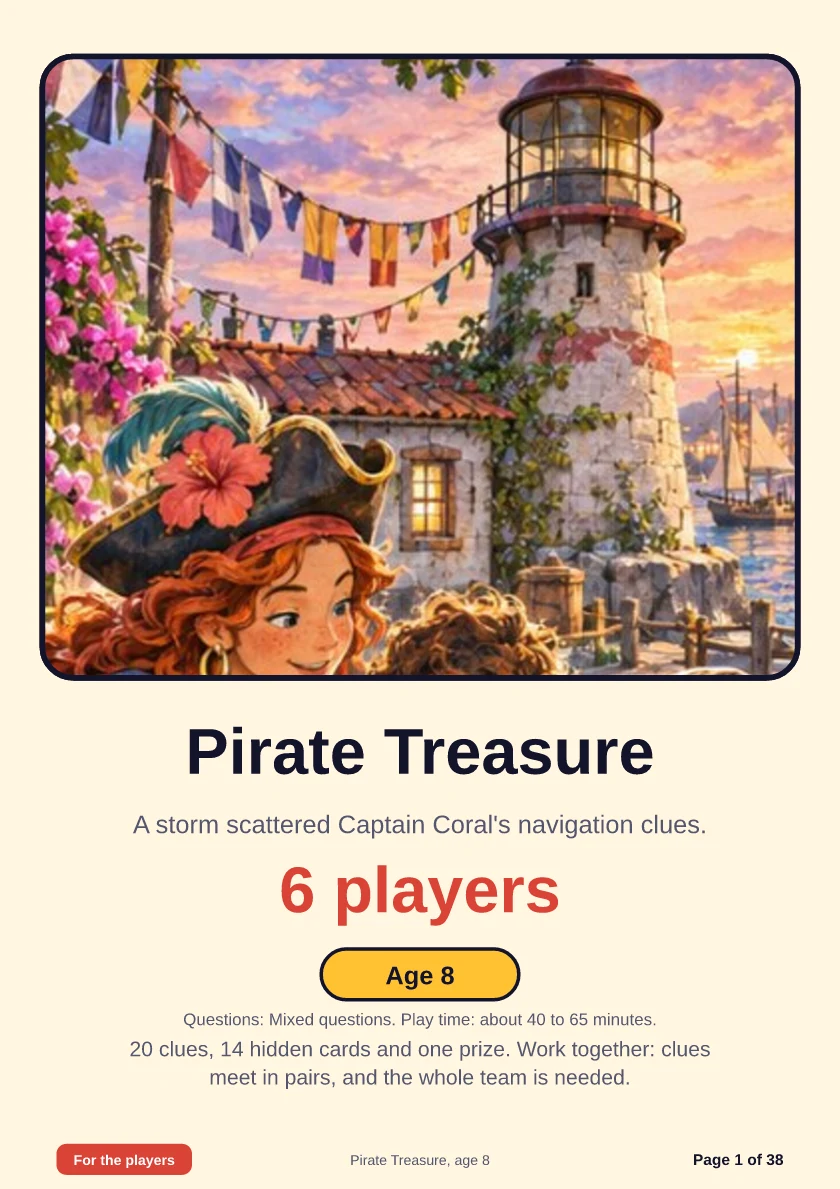
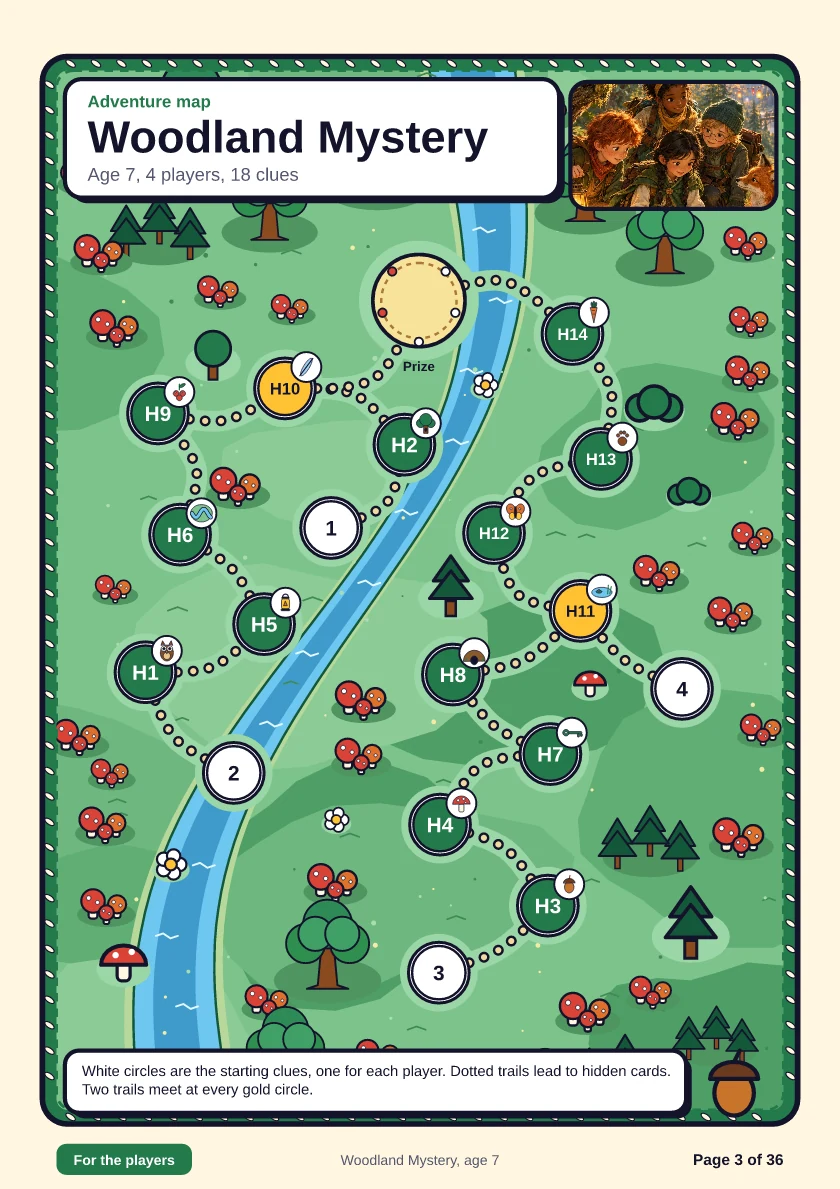
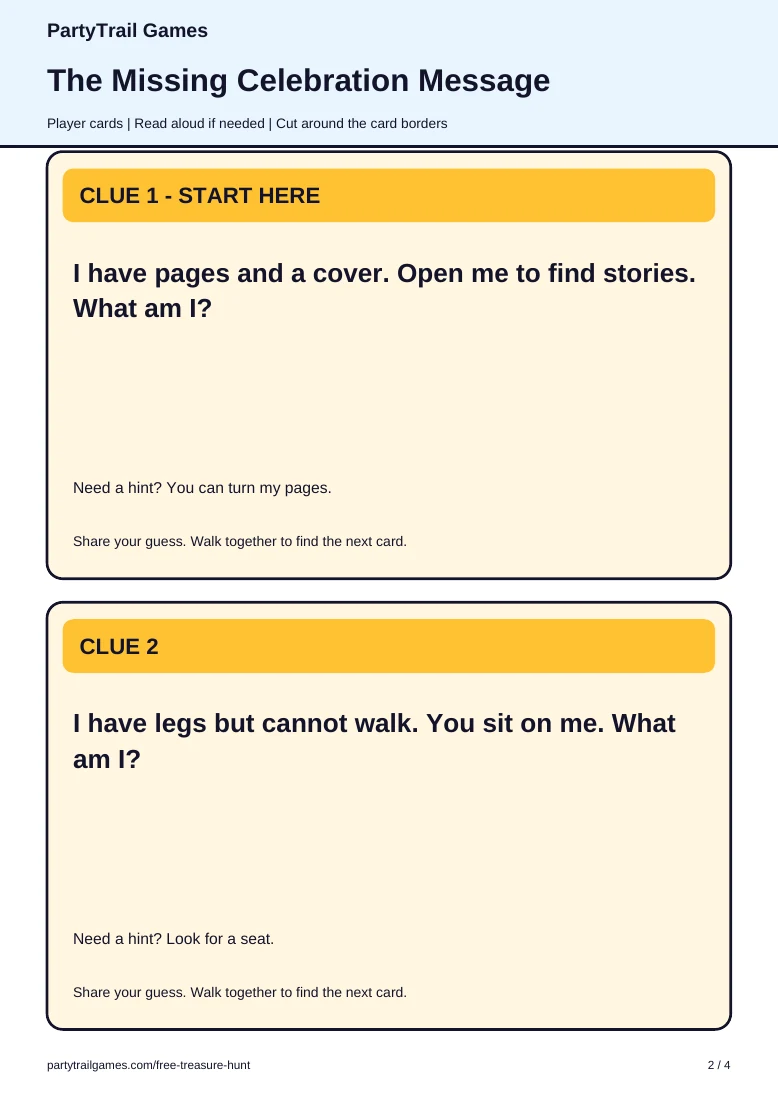
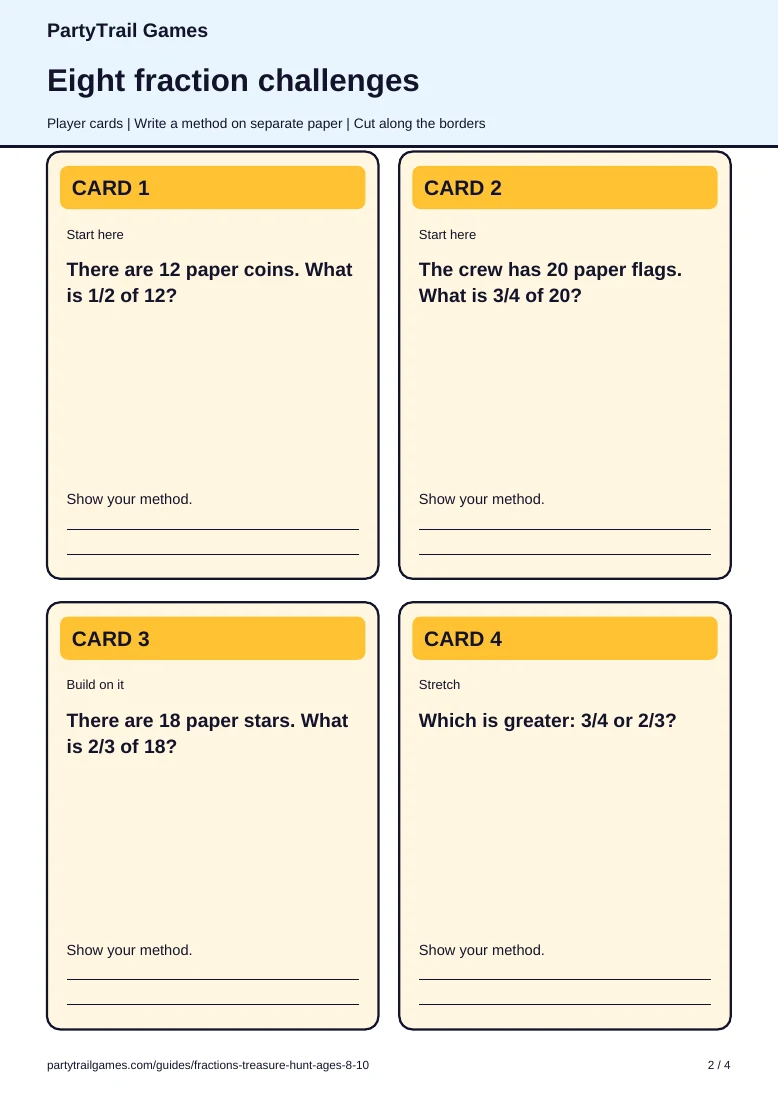
See an actual Pirate Treasure pack
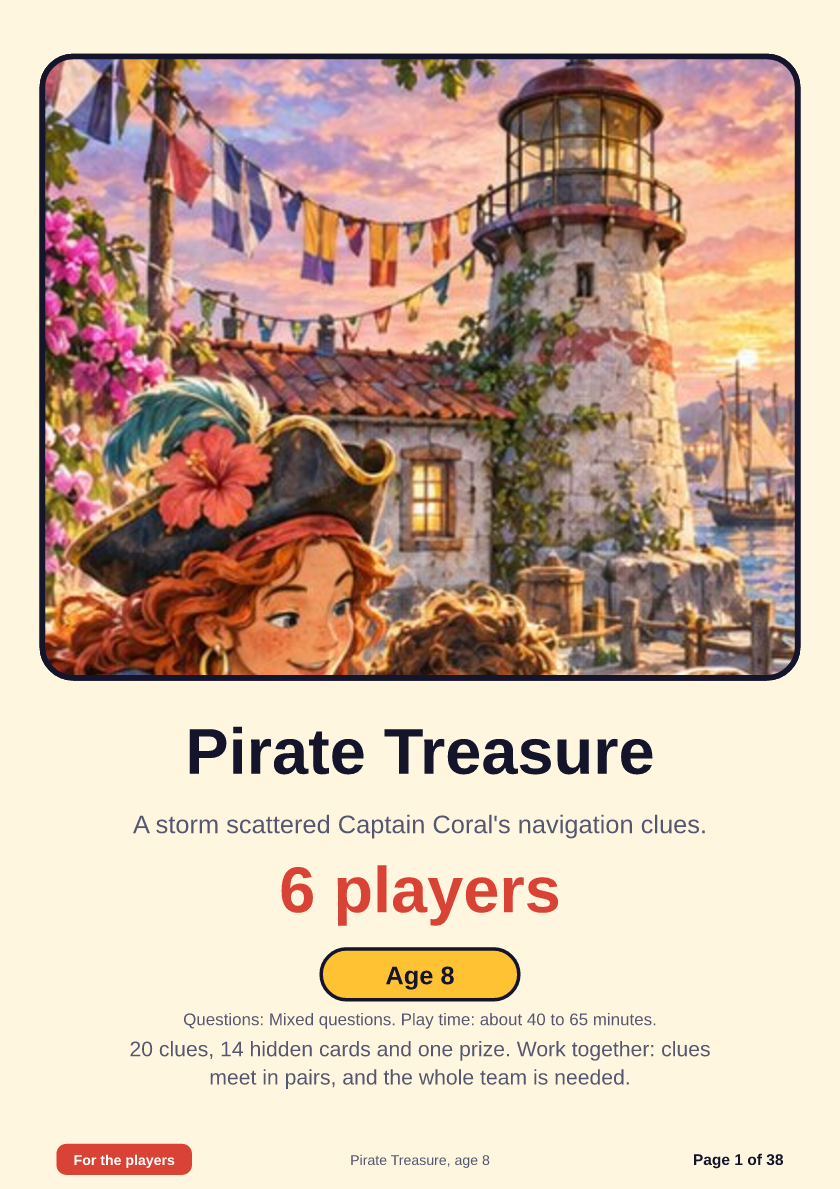
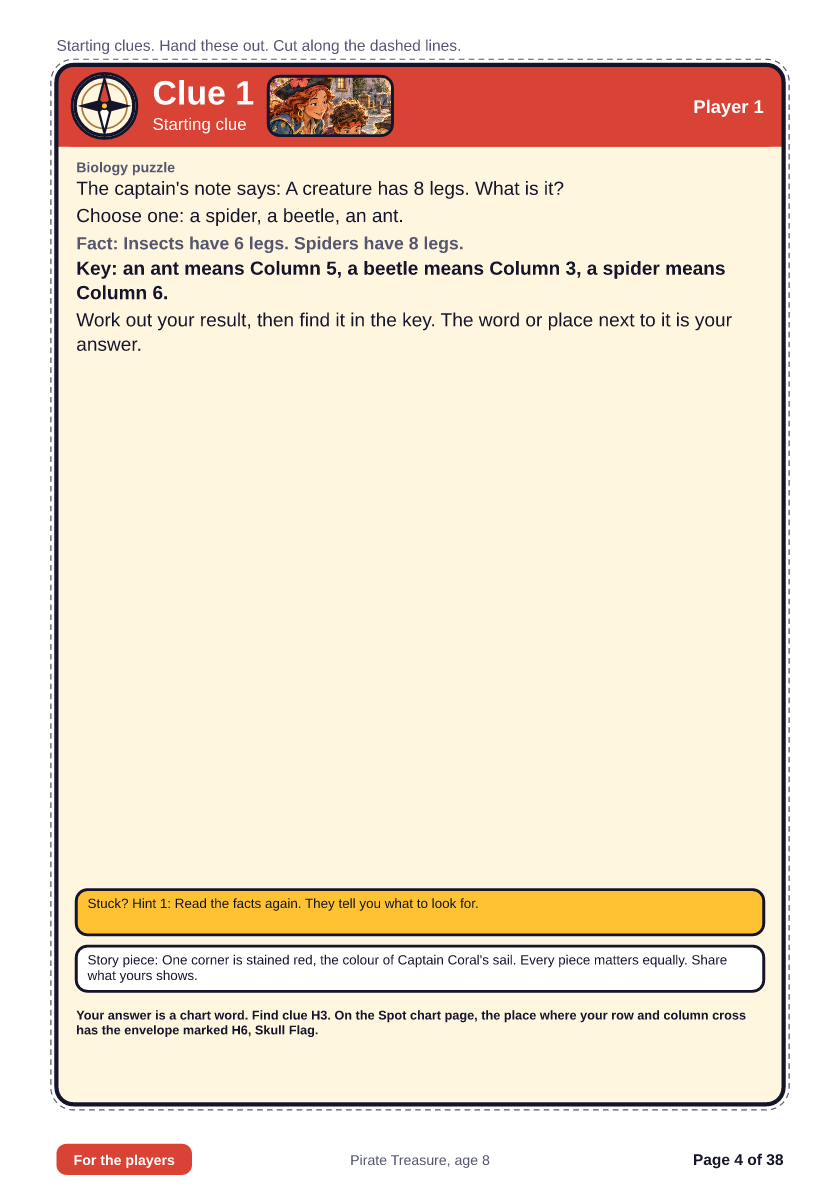
These pages come from a newly generated Pirate Treasure demo for six players aged eight. Your own game will reflect the choices you make in the builder, including the player count, questions and hiding places.
An envelope with certificates, a crew photograph you keep for the family, or a note announcing the next party activity can make a satisfying finish. Agree how physical prizes will be shared so the final discovery belongs to the whole crew.
Common questions
Do I need pirate costumes or a treasure chest?
No. Paper clues, envelopes and a finishing message can carry the adventure. A decorated box or costumes are optional additions.
Can I play with children of different ages?
Yes. Choose a suitable age setting, check the preview and use shared roles. An adult can read aloud or help a younger player while older children explain their thinking.
Can I move the printed cards into a simpler order?
A generated pack has a specific cooperative route. Use its adult map and placement guide; changing the order independently can break the connections between clues. Choose your actual hiding places before generating the game.
Captain Coral needs a crew
Choose your players, age and hiding places, then preview your own Pirate Treasure adventure.
Create a pirate treasure huntWant a short activity first? Try the free five-clue mini hunt