Classroom activities
10 low-prep learning activities for primary classrooms
Practical starters, partner challenges and a cooperative trail, with questions that invite explanations.
A useful classroom activity gives pupils something concrete to do and a reason to explain their thinking. Start with the skill you want to practise, choose an activity that fits the available time, and keep a short discussion at the end.
These 10 ideas use paper, pencils and ordinary classroom materials. Most can be prepared in five minutes or less when the supplies are ready. The cooperative treasure hunt is the longer-preparation option: print, check and place its cards before the lesson. Age ranges and times are planning suggestions; adapt them to your pupils and setting.
Choose a format that fits the lesson
For a ten-minute starter, choose “Which one does not belong?”, a mistake detective task or an estimate. For a longer session, try a design challenge, a paper algorithm or a cooperative trail. Pairs and groups of three or four can share resources in a class of up to 30; decide roles and distribute materials before beginning.
A pupil can point, speak, draw, dictate or use their usual communication support to show an idea. Provide written directions as well as spoken ones when helpful. Use tabletop versions wherever movement around the classroom would make participation harder.
1. Ask “Which one does not belong?”
- Ages
- 5–12, with suitable examples
- Group
- Think individually, then compare in pairs
- Preparation
- 2 minutes
- Playing time
- 8–12 minutes
Materials: A board or four paper cards and pencils.
Learning goal: Classify examples and justify a choice using a shared property.
How to play
- Display four numbers, shapes or words. For a number example, use 8, 12, 15 and 20.
- Give thinking time, then ask partners to choose an item and explain a property that separates it from the others.
- Collect more than one defensible answer and ask pupils to check each explanation against all four items.
Make it easier
Use three triangles and a square, with large clear drawings.
Add a challenge
Find two different valid answers for the same set, or create a new set for another pair.
Talk about it: Can 15 and 8 both be reasonable choices in the number example?
Show answer and explanation
Yes. 15 is the only odd number; 8 is the only single-digit number. Each explanation identifies a property that separates its chosen number from the other three.
2. Become maths mistake detectives
- Ages
- 6–12, using familiar maths
- Group
- Pairs or groups of three
- Preparation
- 2–4 minutes
- Playing time
- 10–15 minutes
Materials: A board or paper with one deliberately incorrect worked example.
Learning goal: Locate an error, correct it and explain the underlying operation.
How to play
- Write: “4 × 3 = 4 + 3 = 7.” Tell pupils that the example contains a mistake.
- Ask them to mark the first step that goes wrong and represent the correct calculation with a drawing or counters.
- Invite each pair to explain the correction, then give a similar question such as 5 × 3 to check the method again.
Make it easier
Draw four groups of three marks and count them together.
Add a challenge
Show an incorrect two-step calculation and ask whether a later correct operation can repair the earlier mistake.
Talk about it: What should 4 × 3 equal, and why is adding 4 and 3 a different calculation?
Show answer and explanation
4 × 3 = 12. Four groups of three give 3 + 3 + 3 + 3 = 12. The sum 4 + 3 is 7, which combines two quantities rather than making four equal groups of three.
3. Estimate, explain and check
- Ages
- 5–12
- Group
- Whole class, then pairs
- Preparation
- 3 minutes
- Playing time
- 10–15 minutes
Materials: A clear cup containing large paper counters, plus a counting mat or paper.
Learning goal: Make and refine an estimate, then count systematically.
How to play
- Show the filled cup and ask each pupil for an estimate. Invite a reason, such as comparing the visible amount with a group of five.
- Spread the counters on a table or display a drawing of them. Let pupils revise their estimate using the new information.
- Count in groups of five or ten and compare estimates with the total. Discuss which evidence made the second estimate more useful.
Make it easier
Use a small set that pupils can group into twos.
Add a challenge
Give an interval estimate, then calculate the difference between the final count and a chosen estimate.
Talk about it: Which piece of new information changed your estimate?
4. Draw and describe with a partner
- Ages
- 5–12
- Group
- Pairs
- Preparation
- 3 minutes
- Playing time
- 12–20 minutes
Materials: Two sheets per pair and pencils; a simple model drawing.
Learning goal: Use precise positional language and ask clarifying questions.
How to play
- Give one partner a drawing of a circle with a small triangle above it and a square to its right. Both partners should orient their paper the same way.
- The describer explains the picture without showing it. The listener draws and may ask questions such as “Above the circle or above the square?”
- Compare drawings and identify a helpful instruction. Swap roles with a new picture.
Make it easier
Use two large shapes and allow pointing to a shared bank of position words.
Add a challenge
Add distances measured in centimetres or ask partners to rewrite an ambiguous instruction.
Talk about it: Which word or question removed the biggest uncertainty?
5. Sort observations and preferences
- Ages
- 7–12; adapt to pictures and speech for younger pupils
- Group
- Groups of three or four
- Preparation
- 4–5 minutes
- Playing time
- 12–20 minutes
Materials: Paper statement cards or statements written on the board.
Learning goal: Distinguish a recorded observation from a personal preference.
How to play
- Use a fictional paper-towel investigation. Display: “Towel A absorbed 12 millilitres of water”, “I like towel A’s blue pattern” and “Towel B absorbed 9 millilitres of water”.
- Ask groups to sort the statements into recorded observations and preferences, explaining what makes each statement fit.
- Ask which towel absorbed more water in these recorded results. Discuss what else you would need to know before calling the comparison fair.
Make it easier
Read the cards aloud and use two labelled sorting areas with symbols.
Add a challenge
Add an unsupported claim such as “A is always the best” and ask pupils what evidence is missing.
Talk about it: Do these three statements prove that towel A is always better?
Show answer and explanation
No. The fictional results say A absorbed 3 millilitres more in this comparison. To judge the test, we need details such as equal-sized samples, the same method and repeated observations. A preference for its colour does not measure absorption.
6. Build, test and improve a paper tower
- Ages
- 5–12
- Group
- Groups of three or four
- Preparation
- 3–5 minutes with tape portions ready
- Playing time
- 20–30 minutes
Materials: One similar sheet per team, equal short tape portions and a ruler.
Learning goal: Design within constraints, measure a result and explain an improvement.
How to play
- Give each team the same paper and tape allowance. Ask for a tower that stands on a table without being held or fixed to the table.
- Let teams build, then measure from the tabletop to the highest point that stays standing. Record both the height and anything they notice about the base.
- Let teams redesign using the same allowance. Compare each team’s two versions and explain what changed.
Make it easier
Provide a folded or rolled starting shape and focus on making it stand.
Add a challenge
Keep a labelled drawing of each version and change one design feature deliberately.
Talk about it: What evidence suggests that your change helped? Would another test give the same result?
7. Debug a paper explorer’s instructions
- Ages
- 7–12; use a smaller grid with younger pupils
- Group
- Pairs
- Preparation
- 3 minutes
- Playing time
- 12–20 minutes
Materials: A drawn four-by-four grid, a paper explorer and pencils.
Learning goal: Follow a sequence, locate an error and check a corrected algorithm.
How to play
- Label columns A–D from left to right and rows 1–4 from top to bottom. Start the explorer at A1 and mark the destination C2.
- Define east as one square right and south as one square down. Give the sequence east, south, south and ask pupils to trace where it ends.
- Ask them to change one instruction so that the three moves finish at C2. Test the revised sequence with the paper explorer.
Make it easier
Use a two-by-two grid and follow one arrow at a time together.
Add a challenge
Add a blocked square, write a new route and ask another pair to test it.
Talk about it: Where does the original sequence end, and which single change reaches C2?
Show answer and explanation
East, south, south ends at B3. Change the second instruction to east: east, east, south goes from A1 to B1, then C1, then C2. The directions are fixed on the page, so the explorer’s facing direction does not change their meaning.
8. Match vocabulary, then use it
- Ages
- 5–12, with vocabulary from the current lesson
- Group
- Pairs or groups of four
- Preparation
- 4–5 minutes
- Playing time
- 10–18 minutes
Materials: Four word cards and four definition or picture cards per group.
Learning goal: Connect a word with its meaning and apply it to an example.
How to play
- Choose four words pupils are learning. For a materials lesson, examples could include transparent, opaque, flexible and rigid.
- Ask pupils to pair each word with a definition and explain a real object that illustrates it.
- Remove the cards and ask each pair to write or dictate one sentence that uses a chosen word accurately.
Make it easier
Use two words, clear pictures and a spoken sentence frame.
Add a challenge
Add a non-example and ask pupils to explain why it fails the definition.
Talk about it: A clear window lets you see objects behind it. Which word fits?
Show answer and explanation
Transparent. In this example, light passes through the material so that objects behind it can be seen clearly. Use a clear picture or a suitable classroom example to connect the word and meaning.
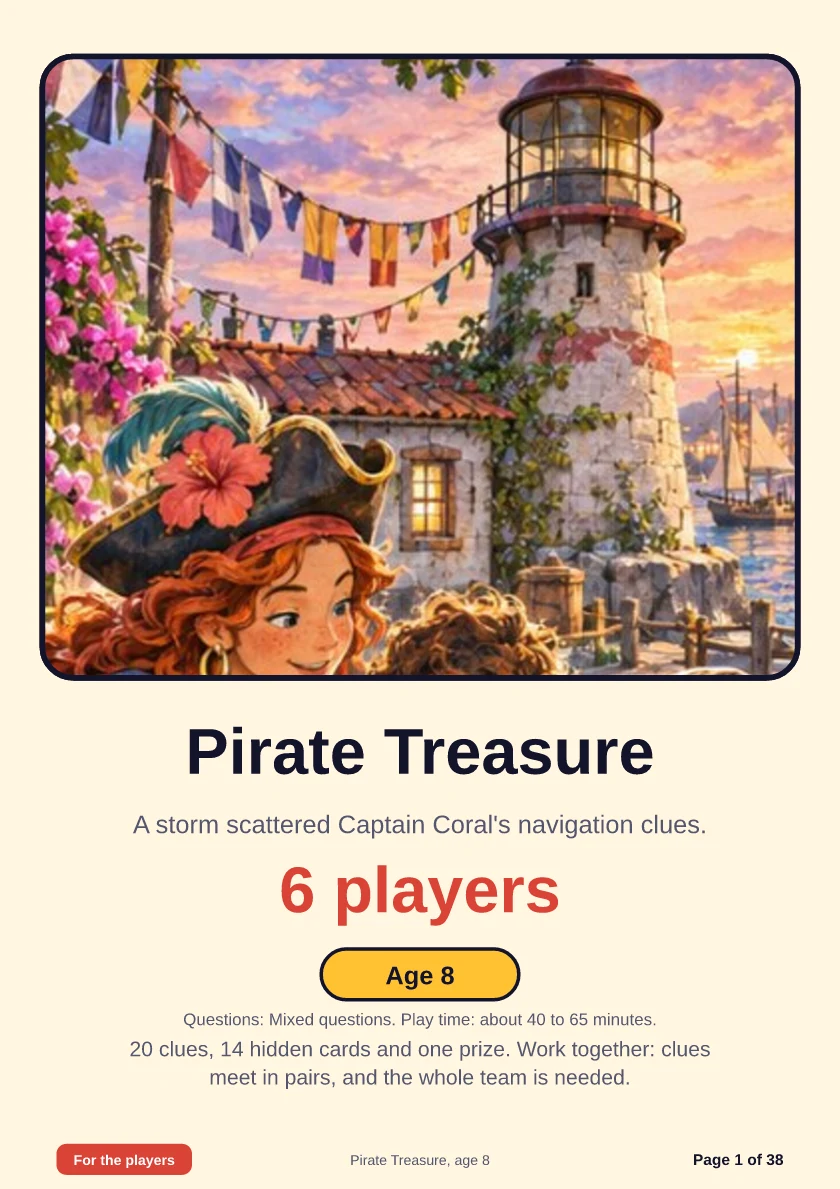
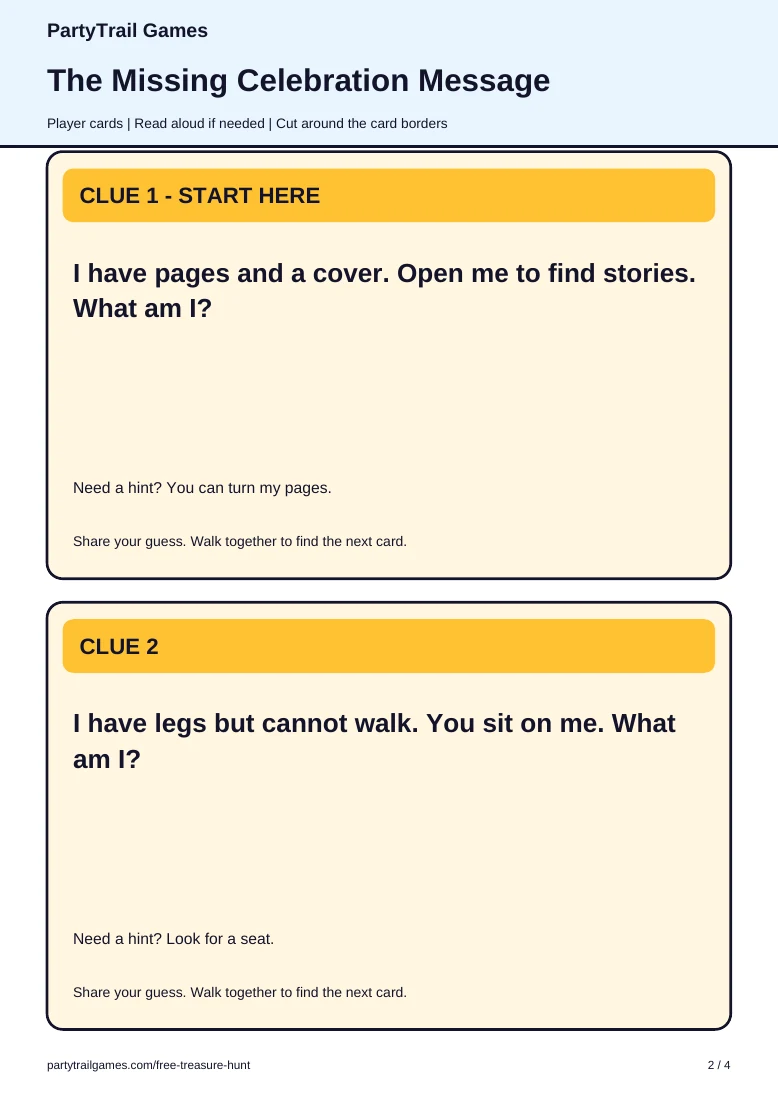
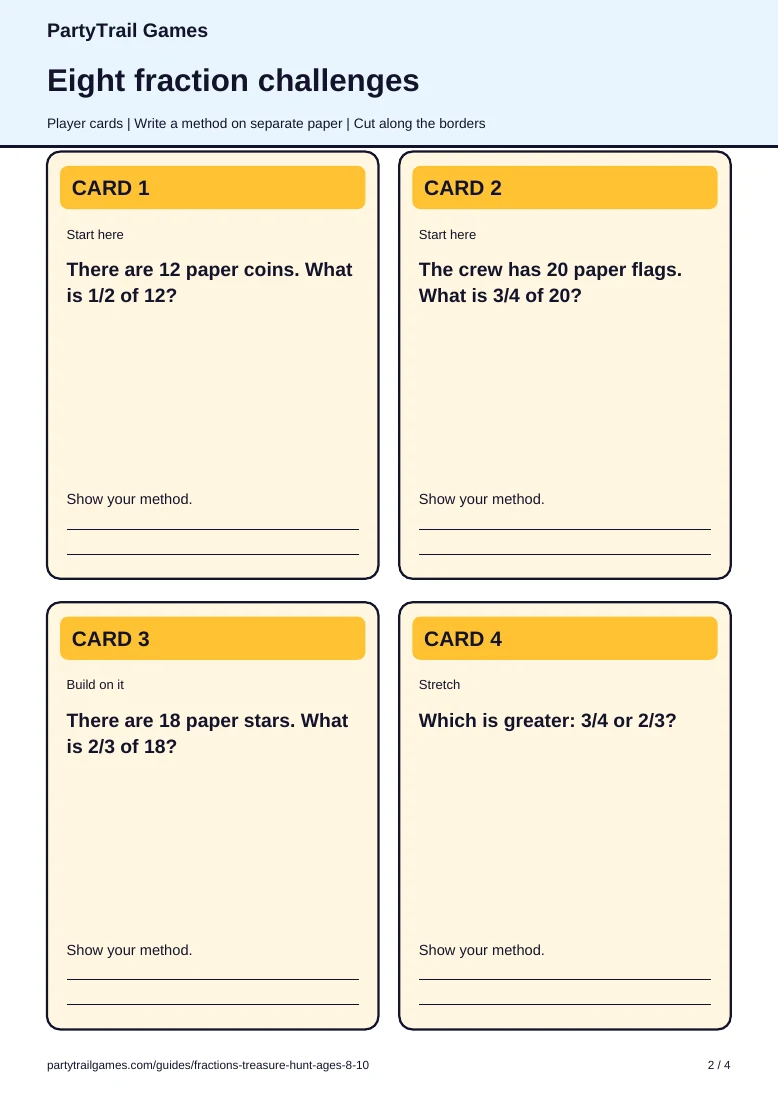
9. Run a cooperative learning trail
- Ages
- 5–12, with questions checked for the class
- Group
- Small teams or a coordinated class of up to 30
- Preparation
- Allow 10–20 minutes after checking and printing; larger packs can need longer
- Playing time
- Use the generated game’s estimate and allow discussion time
Materials: A checked set of clue cards, an adult route and answer copy, and optional envelopes.
Learning goal: Apply selected knowledge, explain answers and combine discoveries towards a shared goal.
How to play
- Choose the learning focus and inspect every question. Plan clear, reachable locations and keep the adult map and answers with the teacher.
- Assign and rotate reader, finder, recorder and checker roles. Use a tabletop delivery version if moving between clues is unsuitable.
- After the final discovery, ask each team to explain one answer and complete an individual follow-up question on the same skill.
Make it easier
Read cards aloud, use familiar vocabulary and give pupils time to show answers with drawings or objects.
Add a challenge
Ask teams to compare two methods or explain why a tempting wrong answer fails.
Talk about it: Which clue needed the most explanation, and what helped your group resolve it?
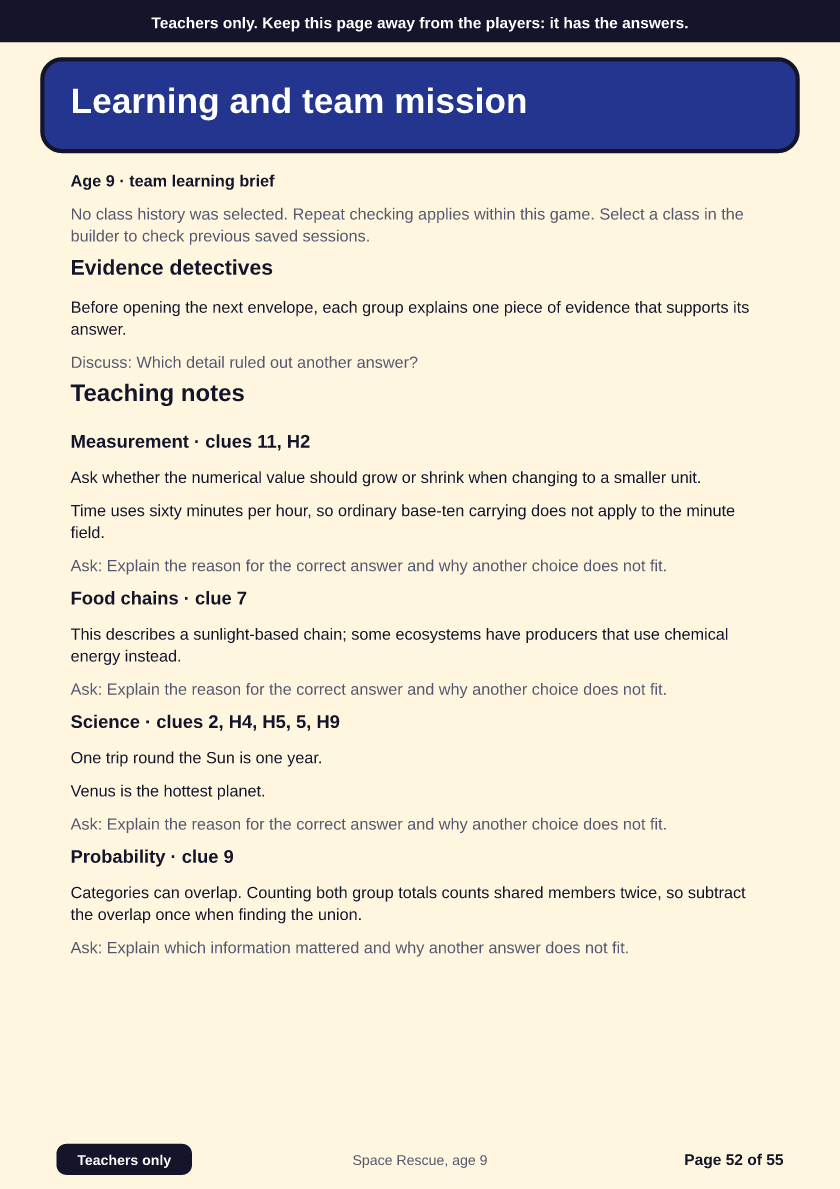
PartyTrail is our personalised printable option for this activity. Choose School classroom, an age and player count, then select the available subjects and topics. The story theme is a separate choice. Check the preview and its adult learning brief before printing; the full pack’s own map controls the route.
10. Swap pupil-written questions
- Ages
- 5–12, with suitable writing support
- Group
- Pairs, then another pair
- Preparation
- 2 minutes
- Playing time
- 15–25 minutes
Materials: Paper and pencils; relevant lesson notes or books for checking.
Learning goal: Construct an answerable question, provide a solution and evaluate an explanation.
How to play
- Ask each pair to write one question using a skill from the lesson. Give a model such as “Five packs contain three pencils each. How many pencils altogether?”
- Keep the answer and a checking method on a separate sheet. Review questions before swapping so that the other pair receives a clear, solvable task.
- The second pair answers and explains. Return the question and let its authors improve any wording that caused confusion.
Make it easier
Use drawings or dictate a question to an adult; give a sentence frame.
Add a challenge
Ask authors to add a helpful hint and a plausible wrong answer with an explanation of its mistake.
Talk about it: What is the answer to the five-packs model question?
Show answer and explanation
15 pencils, because 5 × 3 = 15. Five groups of three marks provide a simple way to check the multiplication.
Finish with a small check of understanding
Reserve two or three minutes for a fresh question using the same idea. Collect a short answer, drawing or spoken explanation from each pupil in the way that suits them. A group’s successful finish can hide differences in individual understanding, so use what you notice to choose the next teaching step.
- Ask pupils to name the evidence or method they used.
- Revisit one error without identifying or embarrassing its author.
- Keep the next example small enough to discuss before the lesson ends.
Common questions
Which activity fits a ten-minute starter?
Try one “Which one does not belong?” set, one deliberately incorrect calculation or a short estimate-and-check task. Use a single example and protect time for pupils to explain their reasoning.
Can these activities work with 30 pupils?
Use pairs or small groups, make enough copies or display the shared prompt, and assign roles. For PartyTrail, choose the actual player count, which can be up to 30, and check the generated route and pack before use.
Do I need to buy classroom resources?
Most ideas use ordinary classroom supplies and the examples on this page. A PartyTrail printable trail is optional. Account allowances and the current price are shown on the website before you choose a game.
Will an activity show that every pupil has understood?
Listen during the activity and follow it with a small individual check. These plans support practice and discussion; use your own judgement and assessment to decide what each pupil needs next.
Turn a learning goal into a shared mission
Explore our classroom options, then choose a story and the learning focus that suits your pupils.
Explore classroom treasure huntsWant a short activity first? Try the free five-clue mini hunt